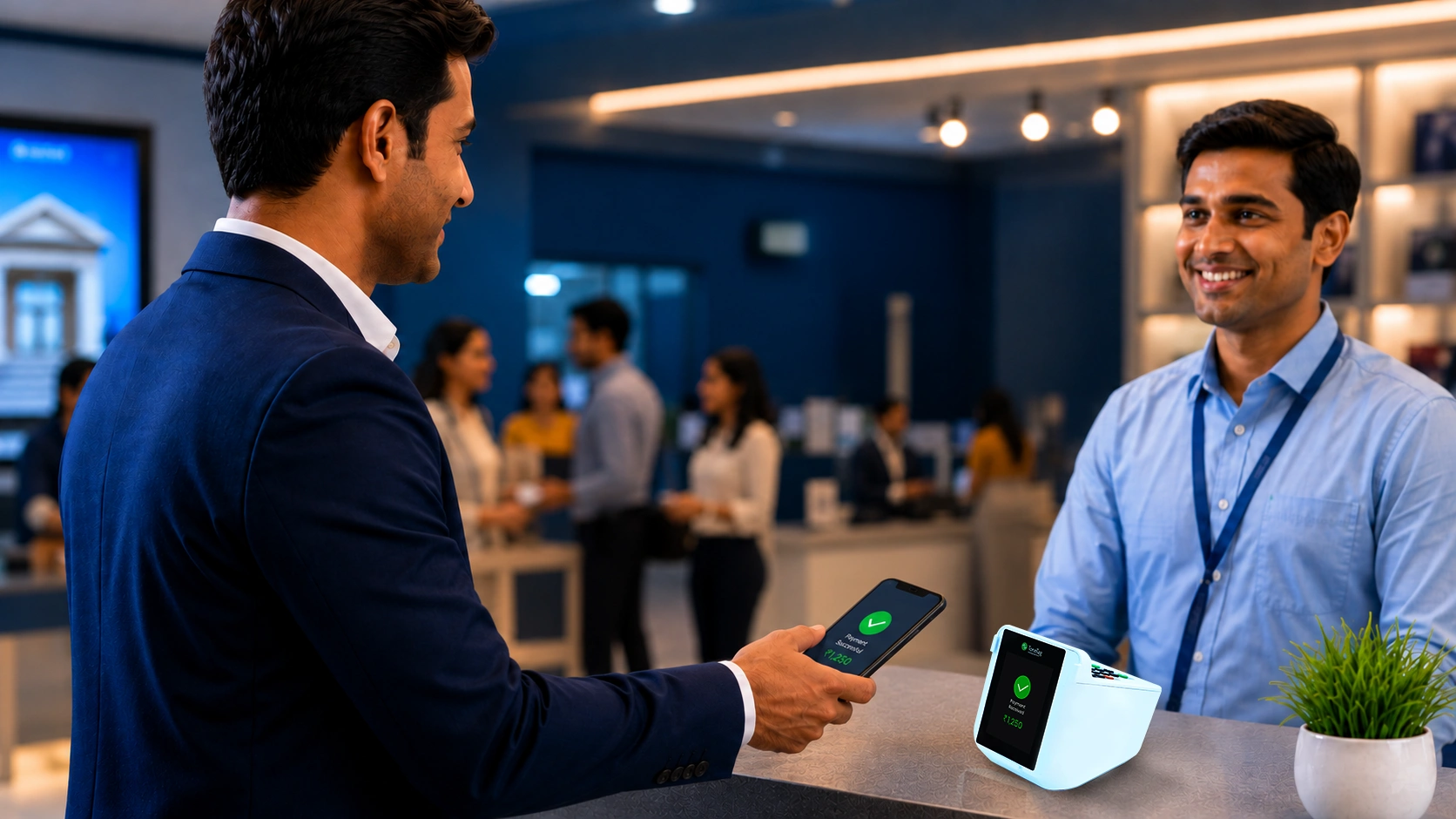
Merchant acquisition in India is no longer a battle for QR codes. It is a battle for merchant-bank relationships. As UPI adoption scales across urban and rural markets, banks need new ways to retain settlement flows, strengthen merchant engagement, and unlock lending opportunities. AI-powered soundboxes are emerging as the most effective tool for that strategy. What began as a simple payment confirmation device has evolved into intelligent merchant infrastructure. Modern AI soundboxes combine conversational AI, business insights, multi-modal payment acceptance, and analytics in a single device. With UPI processing over 24,100 crore transactions in FY2025-26, the institution that controls the device on the merchant’s counter increasingly controls the relationship behind the transaction.
Why Merchant Acquiring Has Become a Hardware Race
For years, banks relied on static QR codes and PoS terminals to enable merchant acceptance. While effective for payment collection, these solutions offered limited engagement beyond the transaction itself.
Fintech players identified this gap early. They deployed soundboxes at scale, bundling instant payment confirmations with analytics, lending triggers, loyalty tools, and daily merchant touchpoints. The result: banks started losing merchant relationships to platforms that owned the device and the data layer above it.
The opportunity ahead is massive. A Kearney and Amazon Pay study projects India’s retail digital payments to double from $3.6 trillion in FY24 to $7 trillion by FY30. Most of this growth will flow through offline merchants in tier-2, tier-3, and rural India. Banks that fail to place intelligent devices at these countertops risk being reduced to backend settlement pipes while competitors own the merchant relationship.
This is why AI soundboxes are rapidly becoming central to modern merchant acquiring strategies.
What Makes an AI Soundbox Different from a Standard Soundbox
A traditional soundbox confirms a payment. An AI soundbox helps manage the merchant’s relationship with their bank.
The latest generation of devices supports conversational AI interaction, real-time settlement and transaction reporting, multi-modal acceptance across UPI, NFC, QR, and emerging rails like CBDC, edge processing for low-connectivity environments, and value-added services including lending, loyalty, and offer broadcasting.
The most significant shift is conversational. Instead of opening an app or calling support, a merchant can simply ask: “What were my sales today?”, “Has my settlement been credited?”, “Am I eligible for a business loan?” The device responds instantly, in the merchant’s preferred language. This transforms the soundbox from a notification speaker into an always-available banking assistant at the counter.
Solutions like eKosha, built on ToneTag’s protocol, represent this shift. eKosha processes payments locally through on-device authentication, supports voice-first interaction in all Indian languages, and functions as a full merchant banking channel rather than a passive alert device. Its Edge AI capabilities run transaction processing, voice recognition and merchant interactions directly on the device, removing cloud dependency, cutting server load and bandwidth costs for the bank. This local-first model also keeps the device reliable in low-connectivity environments where central acquiring systems often struggle.
Beyond cost efficiency, eKosha opens new revenue layers by acting as a daily distribution channel for merchant lending, insurance, working capital products, loyalty programs, and merchant-funded advertising.
How Banks Are Deploying AI Soundboxes to Gain Ground
Banks are treating AI soundboxes as merchant engagement infrastructure, not merely a payment acceptance device. The deployment playbook is becoming clearer across India’s acquiring ecosystem.
Strengthening CASA relationships. A bank-branded soundbox ensures that merchant settlement flows stay within the bank’s accounts. This directly supports current account and savings account volume, which banks lose when fintech platforms intermediate the settlement layer.
Expanding reach across Bharat. Multilingual voice interfaces and edge processing make AI soundboxes especially valuable for merchants in semi-urban and rural markets. The proximity payments protocol powering devices like eKosha enables transactions even in intermittent-connectivity zones, which is critical for Bharat-scale deployment where smartphone literacy and internet reliability remain inconsistent.
Turning transaction data into lending signals. Transaction activity captured through the device provides banks with granular insight into payment frequency, average ticket size, seasonal patterns, and cash flow behaviour. These signals strengthen underwriting and fuel merchant lending opportunities, working capital advances, and insurance cross-sell.
Increasing merchant retention. When a merchant relies on a single device for payment confirmation, business insights, settlement tracking, and banking assistance, switching to a competitor becomes significantly less attractive. The device creates daily utility that static QR codes never could.
The Economics and Intelligence Layer Behind Deployment
For banks, the business case extends beyond payment acceptance. Acquiring a merchant incurs operational costs in onboarding, servicing, and infrastructure. Every retained merchant creates compounding revenue opportunities.
AI soundboxes generate a rich transaction intelligence layer that includes payment frequency, average values, settlement behaviour, and growth trends. This data supports merchant cash advances, working capital lending, insurance distribution, loyalty programs, and merchant-funded promotional campaigns.
Behind the scenes, AI helps banks generate value that merchants never see directly. By analysing transaction patterns across the network, banks can detect fraud, improve merchant segmentation, surface predictive business insights, and deliver more relevant financial products. This transforms the soundbox from a payment device into an intelligent merchant engagement platform that supports both the merchant’s daily operations and the bank’s strategic growth.
ToneTag’s protocol supports this full stack through agentic AI payments capabilities, where the device identifies merchant intent, completes transactions, and surfaces contextual banking actions without requiring the merchant to navigate an app.
Why Timing Matters: The NPCI Interoperability Push
NPCI is developing a unified, interoperable soundbox platform that would allow a single device to confirm transactions from all UPI apps. This shifts competitive advantage away from QR-level lock-in toward device intelligence and merchant services.
Once payment confirmation becomes standardized, differentiation will depend entirely on what the device delivers beyond the chime: merchant analytics, conversational banking, lending enablement, and business insights. Banks that deploy intelligent soundboxes now will own the relationship layer even after interoperability levels the payment confirmation field.
PwC projects that 54 million soundbox devices will be deployed across India by FY29. The question is no longer whether to deploy, but how fast banks can deploy with the right intelligence built in.
What Defines an Enterprise-Grade AI Soundbox for Banks
Banks evaluating technology partners for their acquiring strategy should prioritise capabilities that support long-term merchant engagement, not just short-term device placement.
The right partner delivers edge-first architecture that reduces cloud dependency, conversational AI with multilingual voice interaction, protocol-level flexibility across UPI, NFC, QR, sound-based payments, and CBDC, SDK and API readiness for fast integration with existing acquiring stacks, centralised terminal management for remote monitoring and updates, and merchant analytics that feed directly into lending and CRM workflows.
eKosha, built on ToneTag’s protocol, is designed around these requirements. It functions as a conversational AI-enabled merchant banking device that combines payment acceptance, voice-led assistance, merchant analytics, and banking services in a single device. By enabling merchants to interact naturally in their preferred language with their banking ecosystem, it helps banks create deeper engagement while extending digital services beyond traditional mobile applications and branch visits.
The Future of Merchant Relationships Is Voice-First
The merchant acquiring race in India will not be won through QR deployment alone. It will be won through stronger merchant engagement, richer data intelligence, and infrastructure that creates value every day.
AI soundboxes sit at the centre of this transformation. They help banks strengthen merchant relationships, generate actionable business insights, support lending, and build long-term loyalty. The next generation of merchant banking will be conversational. Merchants will ask questions, access business insights, explore financing, and interact with banks for financial services, just by speaking to the device that’s already present at the merchant counter, in their preferred language.
For banks ready to move, the starting point is clear.
Exploring how edge-first, voice-enabled devices can power your merchant acquiring strategy? Talk to the ToneTag team or explore the hardware product range.
Frequently Asked Questions
What is an AI soundbox for merchant payments in India?
An AI soundbox is an intelligent merchant-facing device that goes beyond standard UPI payment confirmation. It accepts multiple payment modes including UPI, NFC, QR, and CBDC, while providing real-time voice interaction in their preferred language. Unlike basic soundboxes that only announce transaction amounts, AI soundboxes deliver business insights, settlement updates, and merchant banking services directly at the counter. Banks in India are deploying these devices to strengthen merchant acquiring relationships and compete with fintech-led acquiring platforms.
How do AI soundboxes help banks win merchant acquiring market share?
AI soundboxes help banks retain merchant settlement flows within their own accounts by placing a branded, bank-owned device at the point of sale. The device captures granular transaction data that banks use for merchant lending, working capital products, and insurance cross-sell. It also increases stickiness because merchants rely on it daily for payment confirmation, voice queries, and business intelligence. This makes it significantly harder for competing acquirers to displace the bank from the merchant relationship.
What is eKosha and how is it different from a regular payment soundbox?
eKosha is a merchant banking device built on ToneTag’s edge-powered protocol. Unlike regular soundboxes that function as passive notification speakers, eKosha processes payments locally using on-device authentication, supports voice-first merchant interaction in multiple languages, and serves as a full banking node. It accepts UPI, NFC, QR, and sound-based payments, and integrates with bank acquiring stacks through plug-and-play SDKs and APIs. This makes it a merchant acquiring tool, not just a payment alert device.
Why are banks in India investing in soundbox deployment for merchant acquiring?
Banks are investing because fintech platforms captured merchant relationships by owning the device layer at the counter. With UPI transactions crossing 24,000 crore annually and NPCI moving toward interoperable soundbox standards, banks risk losing acquiring relevance if they do not place intelligent devices with their merchants. AI soundboxes allow banks to retain CASA volumes, capture transaction data for lending, and deliver value-added services that reduce merchant churn across tier-1 to rural India.
Can AI soundboxes work in rural India with limited internet connectivity?
Yes. The best AI soundboxes use edge-first architecture, meaning they authenticate and process transactions locally on the device without constant cloud connectivity. Devices like eKosha use ToneTag’s protocol to handle payments through sound-based proximity and NFC methods, which work on feature phones and in low-bandwidth environments. Transactions are queued securely on-device and synced with central banking systems when connectivity is restored, making them reliable across rural, semi-urban, and remote merchant locations in India.