
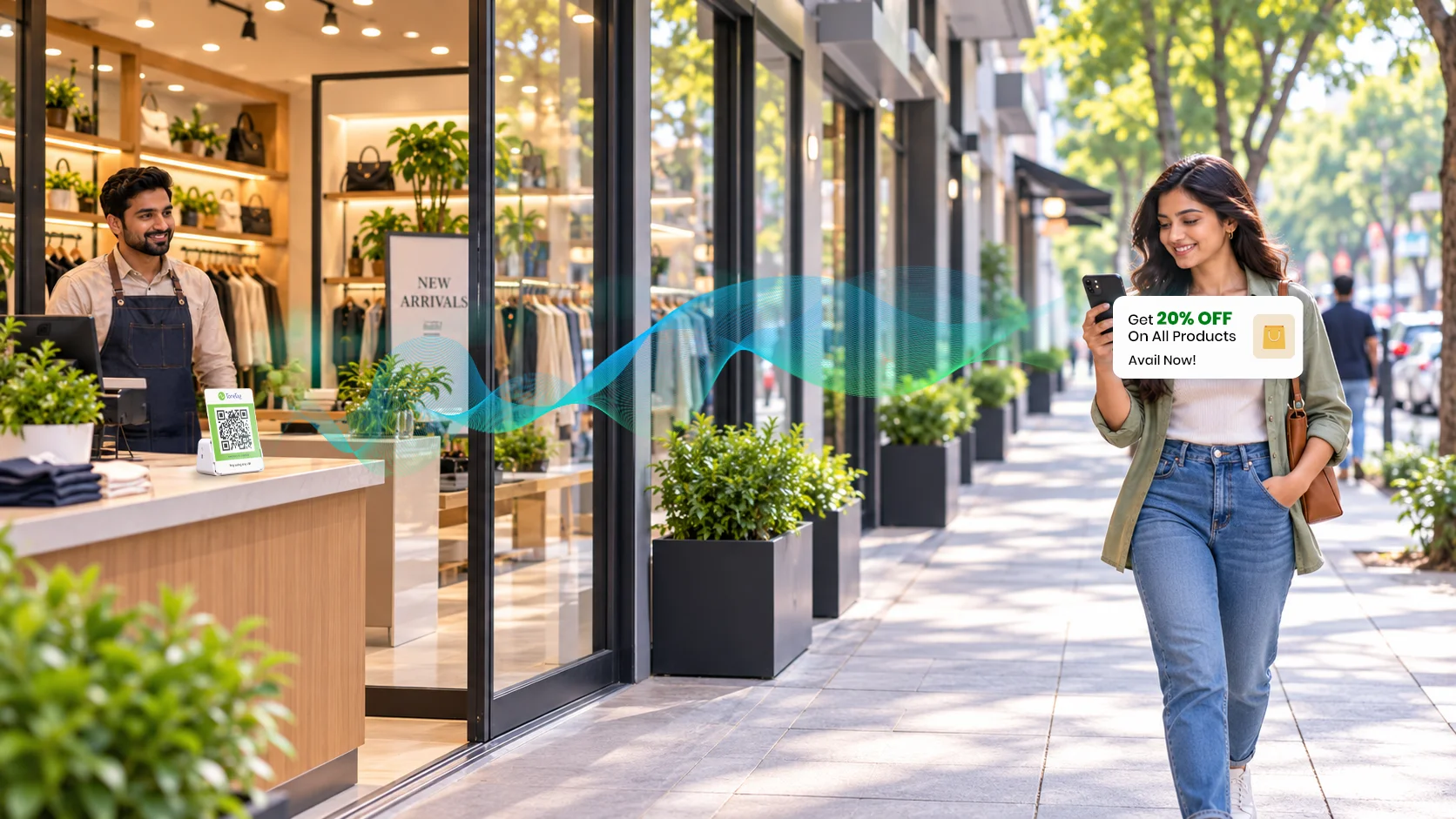
Proximity is quietly becoming the most contested layer of the payments stack. Banks, PSPs, acquirers, and network partners are being asked to support checkouts that happen without an app open or without a card tapped. The rails were not designed for this. Yet queues at Quick Service Restaurant counters, fuel forecourts, transit gates, and connected car dashboards keep pointing to the same requirement, which is faster, contextual, hardware-flexible acceptance.
This guide breaks down what proximity payments actually are, how the underlying technology works, and what payment infrastructure providers should evaluate before integrating.
What Proximity Payments Really Mean
Proximity payments let a customer complete a transaction because they are physically near a terminal, device, or acceptance point. There is no manual scan, no app launch, and often no visible input. Presence, intent, and context do the work.
The category is broader than tap-to-pay. It includes Near Field Communication (NFC), Quick Response (QR) codes, Bluetooth Low Energy (BLE), and data-over-sound protocols that use ordinary speakers and microphones as the transport layer. What unites them is the design principle, which is minimum friction between the customer and the completed payment. For infrastructure providers, that shifts the value question from “which rail” to “which combination of rails, devices, and signals will scale across acceptance environments we do not fully control.”
How the Technology Works Under the Hood
A proximity transaction moves through four stages. Each one has integration and security implications for the provider.- Detection. The device or terminal senses a customer nearby using one or more signals, such as an NFC field, a BLE beacon, an audio tone emitted at short range, or a scanned QR.
- Intent and context. The system reads situational cues like location, cart value, or a conversational command to confirm the customer actually wants to pay.
- Authentication. Identity is verified on the device using secure elements and biometrics where available, reducing real-time cloud dependency.
- Authorisation and settlement. The transaction is routed through the existing card, UPI, or wallet rail, with the acquirer and issuer handling clearing as they normally would.
The Technologies Enabling Proximity Payments
No single technology owns proximity. Infrastructure providers should think in terms of a stack, not a standard.
- NFC is the incumbent, well suited to tap-to-pay cards and NFC-enabled phones. It requires certified terminals and specific hardware.
- QR codes, especially dynamic QR, dominate emerging markets. They are cheap to deploy but shift friction to the customer.
- BLE beacons enable hands-free flows, useful for fuel and mobility, but need battery-powered infrastructure and app presence.
- Data-over-sound uses inaudible audio signals transmitted through standard speakers and microphones, letting almost any device become a payment endpoint without new hardware. This is the layer that lets feature phones, kiosks, and IoT devices participate in the same acceptance network.
ToneTag’s protocol combines these modes into a single interface. eKosha, ToneTag’s edge AI merchant device, is one example of how conversational intelligence, on-device authentication, and multi-rail acceptance are being packaged for merchant environments where connectivity, literacy, and hardware costs are all real constraints. Its positioning, Banking Beyond Branches – Voice-First for Every MSME, reflects where the category is moving, which is toward acceptance that adapts to the environment rather than the other way around.
Why Payment Infrastructure Providers Are Paying Attention
The commercial signal is hard to ignore. The Business Research Company estimates the global proximity payment market grew from USD 22.2 billion in 2024 to USD 25.83 billion in 2025, at a compound annual growth rate of 16.4 percent, with contactless infrastructure expansion and consumer convenience preferences cited as the primary drivers (The Business Research Company, 2025). European Central Bank data shows the volume of contactless card payments in the euro area rose sharply through 2023, with values crossing half a trillion euros in a single half-year period (European Central Bank, 2024).
The implication for providers is straightforward. Card-first and app-first rails will keep serving smartphone-heavy segments, but the incremental transaction growth is coming from environments where those rails struggle, which includes offline merchants, feature-phone users, connected devices, and voice-driven interfaces.
What Integration Looks Like for Existing Stacks
Most infrastructure providers do not want a rip and replace. The relevant question is how much stack change proximity acceptance actually demands.
A well-designed proximity protocol should sit alongside existing rails, integrate through SDKs and APIs, and route through the same acquiring relationships already in place. Key evaluation criteria for a payments architect include:
- Hardware neutrality. Does the protocol require proprietary terminals, or can it run on speakers, mics, and standard chips?
- Rail compatibility. Does it support UPI, cards, wallets, and account-to-account flows without forcing a new merchant onboarding?
- Edge readiness. Are authentication and detection handled on-device, reducing cloud exposure and infrastructure cost?
- Extensibility. Can the same layer support IoT payments on cars, kiosks, and appliances as new use cases emerge?
Security posture matters here. Look for end-to-end encryption, tokenised credentials, secure elements, and on-device biometric authentication. Certification specifics should be validated with the vendor in writing rather than assumed.
Where This Is Heading and Why It Matters Now
Proximity is the on-ramp to what comes next, which is agentic AI payments, autonomous devices settling their own transactions, and voice-first commerce inside cars, kiosks, and appliances. eKosha and similar edge-first designs point to a broader pattern, which is that the next generation of acceptance will be defined by protocols that work across form factors, not by any single terminal. For payment infrastructure providers, the practical move is to start evaluating proximity protocols now, map them against current SDKs and acquiring flows, and pilot in the environments where card and app rails are already showing friction. Teams ready to explore integration paths can talk to ToneTag to scope a fit for their stack.
Frequently Asked Questions
What are proximity payments and how do they differ from contactless payments?
Proximity payments are a broader category that includes any transaction triggered by a customer being physically near a terminal or device, using NFC, QR, BLE, or data-over-sound. Contactless payments usually refer specifically to NFC card and phone taps. Proximity is the umbrella. It covers hands-free flows, voice-triggered checkouts, and payments completed on IoT devices where a tap is not practical. For payment infrastructure providers, the distinction matters because proximity opens acceptance points that card-only contactless rails were never designed to serve, such as feature phones and connected devices.
Why should banks and payment infrastructure providers care about proximity payments now?
The proximity payment market is growing at roughly 16 percent annually according to industry research, driven by contactless infrastructure expansion and consumer preference for lower-friction checkouts. For banks, PSPs, and acquirers, this growth is concentrated in environments where existing rails struggle, including offline merchants, transit, mobility, and IoT. Delaying integration risks ceding acceptance share to competitors already deploying multi-modal protocols. Adopting a proximity layer that sits alongside existing UPI, card, and wallet rails is typically lower risk than waiting for a single dominant standard to emerge across every use case.
How does data-over-sound proximity payment technology work in practice?
Data-over-sound uses inaudible audio signals transmitted through standard speakers and received through standard microphones. A merchant device emits a short encrypted tone, the customer’s phone or a device such as eKosha decodes it, and the transaction is authenticated and routed through existing payment rails. Because it works on hardware that already exists in nearly every phone, kiosk, and connected device, it removes the need for specialised terminals. This makes it particularly effective for scaling acceptance in feature-phone markets, rural corridors, and IoT environments where NFC deployment is not economical.
What integration effort do proximity payment protocols require for existing stacks?
A well-designed proximity protocol integrates through SDKs and APIs and routes transactions through existing acquiring and settlement flows, which means most banks and PSPs do not need to overhaul their core stack. Typical integration touches the merchant-facing app or terminal software, tokenisation and authentication layers, and reporting or reconciliation systems. Timelines depend on certification, security review, and pilot scope, but hardware-neutral protocols usually shorten deployment because they run on existing devices. Providers should evaluate SDK maturity, developer documentation, and edge processing support before committing to a rollout.
Are proximity payments secure enough for enterprise payment infrastructure?
Proximity payment security depends on the protocol design, not the transport method. Enterprise-grade implementations rely on end-to-end encryption, tokenised credentials, on-device biometric or PIN authentication, and secure elements that keep sensitive data off the cloud during the transaction. Edge processing further reduces attack surface by handling authentication locally. Infrastructure providers evaluating vendors should ask for specifics on encryption standards, key management, and audit posture, and validate any certification claims in writing. Well-implemented proximity protocols meet the same security bar as card and app-based rails while reducing real-time cloud exposure.