
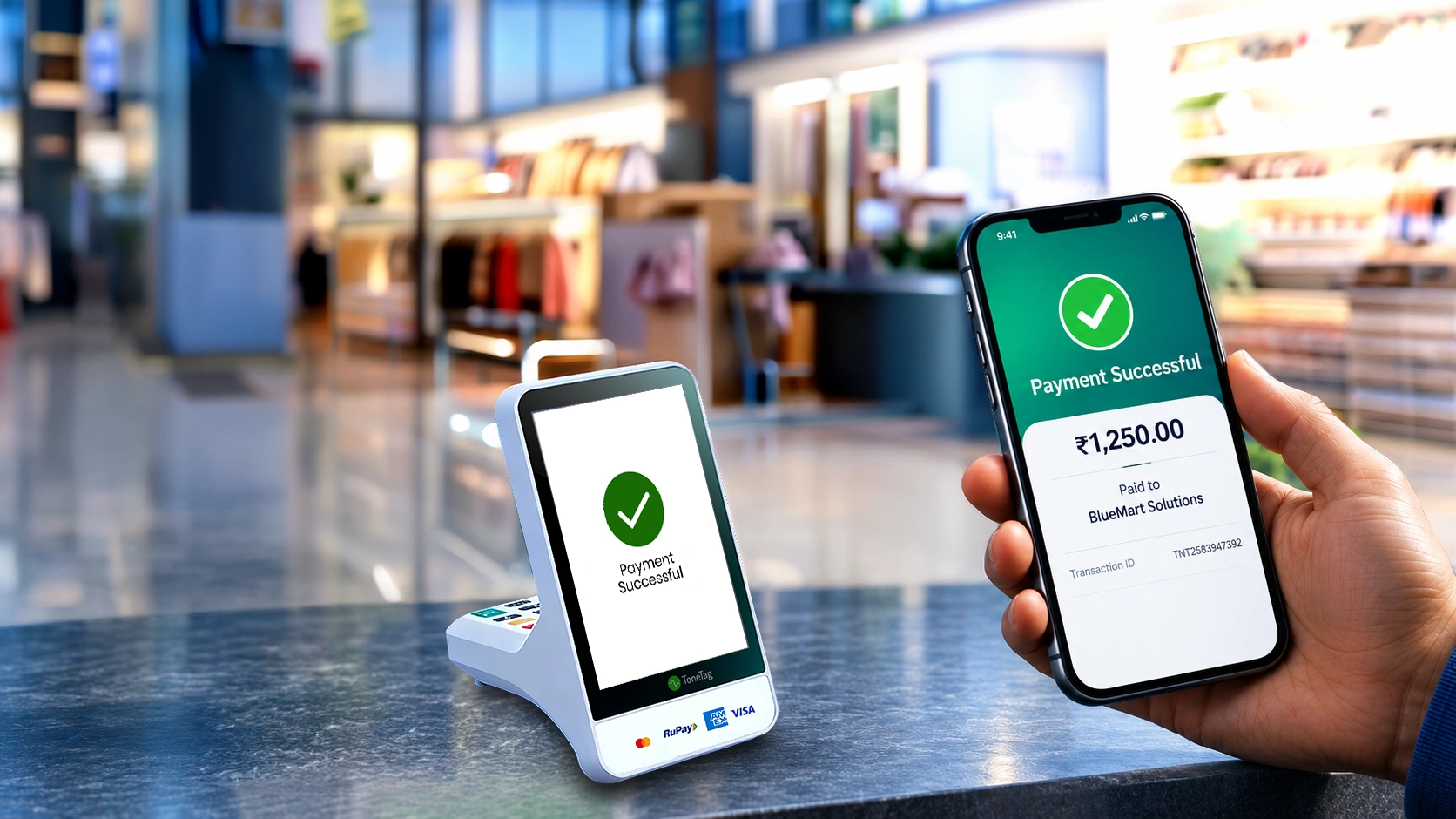
Every time a merchant glances at the payment device on their counter, they see a brand. Right now, for millions of merchants across India, that brand belongs to a fintech, not their bank. Banks are losing the most visible touchpoint in the merchant relationship without realizing what it costs them: data, loyalty, and the ability to cross-sell financial products at the point of transaction. With retail digital payments projected to double to $7 trillion by FY30 according to a Kearney and Amazon Pay study, this gap will only widen.
White label soundbox solutions give banks a way to reclaim the merchant counter, putting their brand on a production-ready device without building hardware infrastructure from scratch.
Why Banks Need Branded Soundboxes Now
For years, banks referred merchants to third-party payment providers for acceptance devices, handing over visibility and long-term relationship value in the process. Fintechs filled that gap aggressively. Paytm, PhonePe, and BharatPe now operate millions of soundboxes across India, and PwC projects that 54 million such devices will be deployed by FY29. Every one of those devices carries a fintech brand, not a bank brand.
This matters for three reasons:
- Brand presence at the point of sale. The soundbox is the most visible payment touchpoint at a merchant’s counter. The brand on that device shapes how the merchant perceives the payment relationship.
- Recurring rental revenue. Soundboxes generate predictable monthly income, creating a revenue stream that traditional acquiring models struggle to match.
- Merchant data as a strategic asset. The device captures transaction volumes, peak hours, seasonal patterns, and category mix. That data fuels lending, insurance, and working capital products that represent the real margin opportunity.
Banks that delay white label soundbox deployment risk ceding their merchant base to platform-led acquirers who are already bundling payments with value-added services. In a market where India processed 22.34 billion UPI transactions in April 2026 alone, the scale of opportunity is massive. And with NPCI exploring an interoperable soundbox framework, the window for banks to establish branded device presence at merchant counters is narrowing fast.
What White Label Soundbox Solutions Actually Deliver
A white label soundbox solution provides the bank with a fully branded, production-ready payment device without the cost and complexity of building hardware, firmware, and backend systems in-house. The bank’s logo, colours, voice prompts, and merchant interface sit on top of a proven device and software stack managed by the infrastructure partner.
This goes beyond simple branding. A established white label partner handles device manufacturing, firmware management, IoT payment processing at the edge, SIM activation, multi-language audio configuration, and over-the-air (OTA) updates. The bank focuses on what it does best: merchant acquisition, relationship management, and financial product distribution. For banks evaluating this model, the total cost of ownership drops significantly compared to building an in-house device, which requires dedicated hardware engineering, supply chain management, and field operations teams that most banks are not structured to run.
Protocol-Driven Flexibility Across Payment Methods
The best white label soundbox platforms are protocol-driven and hardware-agnostic. They support UPI, QR, NFC, tap-to-pay, and even sound-based proximity methods, giving banks flexibility to serve merchants across tiers and use cases. eKosha, built on ToneTag’s protocol, is a strong example of this approach. It combines payment confirmation with conversational AI capabilities, on-device authentication, and edge processing, turning the soundbox from a notification speaker into an intelligent merchant-banking channel.
How Banks Can Deploy Branded Devices at Scale
API-First Integration Into Existing Acquiring Stacks
Scaling from a pilot of a few hundred devices to tens of thousands across geographies is where most bank soundbox programs fail. The logistics alone are formidable: procurement, testing, SIM provisioning, merchant onboarding, regional language configuration, field support, and firmware updates across a distributed fleet.
A plug-and-play white label model compresses this timeline. Banks integrate through APIs and SDKs into their existing acquiring stack, avoiding the need for a full infrastructure overhaul. The hardware partner manages device lifecycle from provisioning to field replacement, while a centralized terminal management system gives the bank real-time visibility into device health, connectivity status, and transaction volumes.
Edge Processing for Tier 2, Tier 3, and Rural Markets
Edge processing is a critical capability for scale deployment, especially in Tier 2, Tier 3, and rural markets where connectivity is inconsistent. Devices that authenticate and process transactions locally, with minimal cloud dependency, ensure that merchants in low-bandwidth environments receive the same instant confirmation as those in metros. This is where edge-powered devices like eKosha create a meaningful advantage over cloud-only soundbox architectures, enabling banks to expand their acceptance footprint into markets that fintech-led models often deprioritize.
Multi-Language Audio and OTA Updates
Regional language support is another operational requirement that directly impacts adoption. India’s merchant base expects payment confirmations in their local language. The right white label partner provides multi-language audio out of the box, with the ability to add or update languages remotely through OTA firmware pushes.
Beyond Rental Revenue: Building a Merchant Data Moat
The soundbox itself generates rental income. But the strategic value lies in what the device enables beyond payment confirmation.
Transaction data flowing through a bank-branded soundbox gives the bank a direct, real-time window into merchant business health. This data becomes the foundation for underwriting merchant loans, offering working capital products, proposing insurance, and delivering targeted offers, all without depending on a third-party aggregator’s data pipeline. As PwC’s research on the soundbox economy notes, soundboxes enable acquirers to offer personalized financial products through the transaction insights these devices capture.
Banks that own the device relationship also control the cross-sell surface:
- Promotional audio delivered through the speaker during idle hours
- Screen-based offers on display-equipped models, targeted by merchant category
- Voice-driven interactions through devices with conversational AI capabilities, turning queries into product discovery
This is the shift from a payment device to a merchant banking terminal, and it is where proximity payment protocols and agentic AI converge.
Reclaiming Ownership at the Point of Transaction
White label soundbox solutions offer banks a direct, scalable path to reclaim the merchant counter. The economics are clear: recurring device revenue, deeper merchant data, and a branded presence at the point of transaction. The infrastructure partners and protocols exist today. Banks that move now will own the merchant data moat. Those that wait will rent access to it from the fintechs who built theirs first.
Ready to deploy branded payment devices across your merchant network? Talk to the ToneTag team or explore the hardware product range.