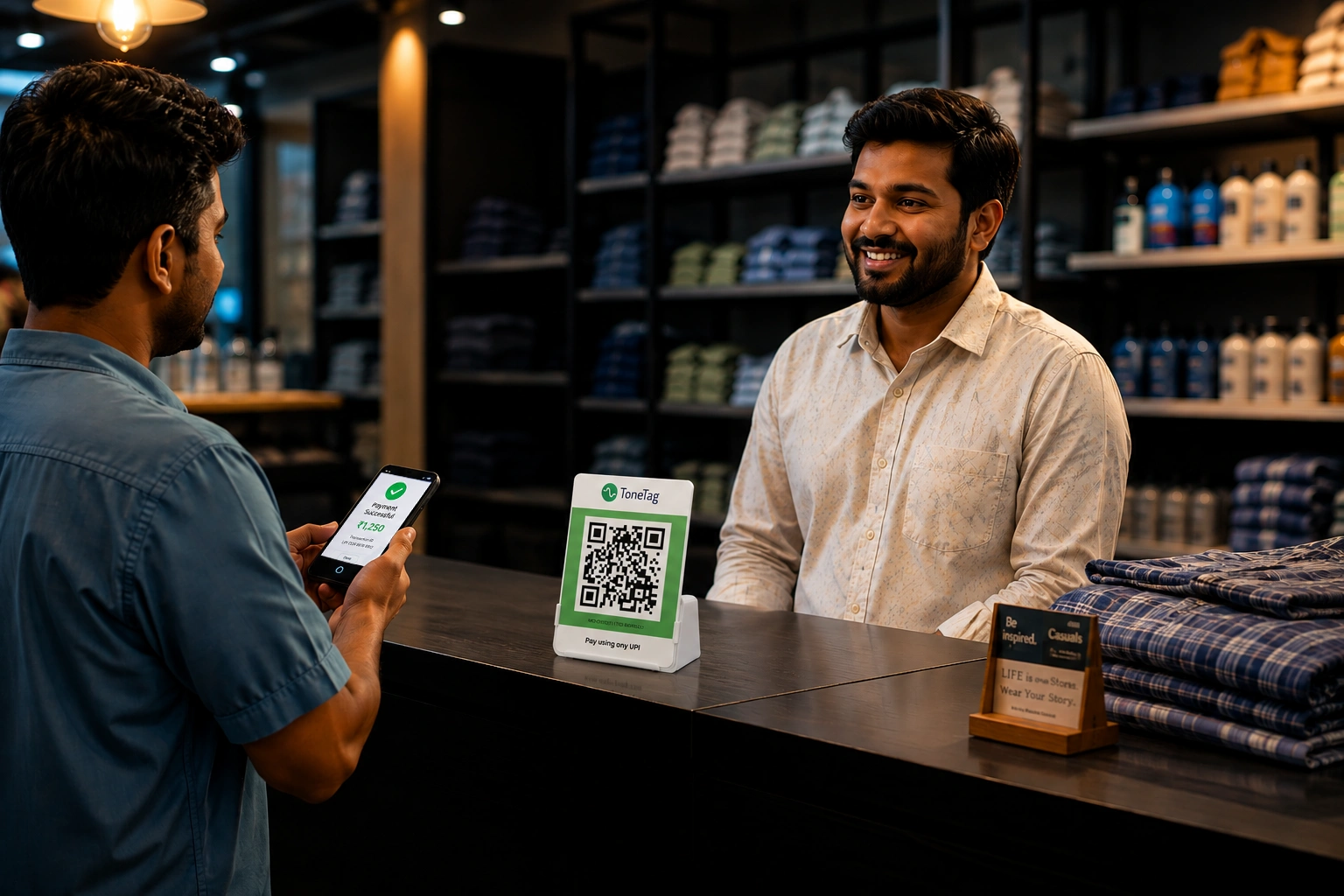
Most merchant counters in India already accept digital payments. Far fewer offer banking. A shop owner can take a UPI payment in seconds, then wait days to check loan eligibility, reconcile yesterday’s sales, or settle a query with their bank. ToneTag eKosha closes that gap. It uses conversational AI to turn a payment device into a banking touchpoint the merchant can simply talk to. This guide explains what that shift means, how it differs from a basic alert device, and why voice-led banking at the counter matters for banks, acquirers, and merchants building for Bharat scale.
What Is a Conversational AI Soundbox?
A device in this category does more than announce a payment. It understands spoken questions, replies in natural language, and acts on the merchant’s behalf. Instead of only confirming “payment received,” it can hold a short exchange about the business itself, in the language the owner is most comfortable speaking.
Picture the difference at a kirana store. A standard device states that an amount was credited. A smarter device responds when the owner asks, in their own language, how the day is going. The hardware can look similar. The intelligence behind it is not.
eKosha, sits in this newer category. It pairs payment acceptance with an assistant that handles real banking questions at the point of sale, not inside an app the merchant rarely opens.
AI Soundbox vs Conversational AI
These two terms get used interchangeably, so it helps to separate them.
A basic AI soundbox usually means a payment device with some intelligence added on top: fraud checks, transaction summaries, or simple voice prompts. The AI supports the payment.
Conversational AI is the layer that lets a person and a machine talk back and forth with context and memory. The merchant asks a follow-up question. The system remembers what was just discussed. It can complete a task, not only report one.
Put plainly:
- A basic device tells the merchant what happened.
- Conversational AI lets the merchant ask what to do next, and gives a useful answer.
eKosha brings the second capability to the counter. The merchant is not studying dashboards. They are having a conversation that ends in an action. That distinction is what separates a smarter alert from a genuine assistant, and it is the line most counter devices have not yet crossed.
How a Voice AI Soundbox Brings Banking to the Counter
eKosha was built with the ideology of “Banking Beyond Branches. Voice-First for Every MSME.” Banking at the counter only works if merchants can ask plainly and get a real answer. A device like eKosha makes that possible by mapping everyday questions to live banking functions, bringing banking closer to where business actually happens.
Consider the questions a busy owner actually has:
- What were my sales today?
- How much did I collect this week compared to last week?
- Am I eligible for a business loan?
- When will today’s payments settle in my account?
Each of these maps to a banking or data function: reconciliation, reporting, credit assessment, or settlement timelines. eKosha handles the question in the merchant’s preferred language and returns a clear answer right at the counter. The countertop becomes a place to run the business, not just collect from it.
This is the heart of bringing banking services to the countertop. The merchant does not visit a branch, wait on hold, or scroll through a smartphone menu during a rush. They ask. They hear. They move on.
Why Edge Processing Makes a Voice First Payment Device Dependable
A counter device that runs on conversation cannot depend on a perfect internet connection. Counters get busy. Networks drop. Many merchants work in areas where data is patchy.
This is why on-device intelligence matters. By processing authentication and core logic on the device itself, at the edge, a banking-grade assistant stays responsive even when connectivity is weak. Sensitive steps can be handled locally, which also reduces real-time exposure to the cloud.
ToneTag’s edge approach, detailed on its IoT Payments page, is built for exactly this. It keeps payment data local with on-device authentication and encryption, then syncs to central systems for settlement and reconciliation when a connection returns. For a banking conversation at the counter, that reliability separates a tool merchants trust from one they quietly abandon. A dependable counter device is one that works in the rush, not only in the demo.
What This Means for Banks and Acquirers in India
India is the right place for this shift. UPI is now the world’s largest real-time payment system, and by FY 2024-25 around 6.5 crore merchants had been onboarded with digital QR acceptance, according to government data. Acceptance is largely solved. The next contest is depth: what else the counter can do.
Two trends make the timing clear:
- Digital payments have moved toward small, everyday transactions and broader inclusion. The RBI Digital Payments Index rose 137% between September 2020 and September 2025, a structural change rather than a temporary spike.
- Financial inclusion keeps widening, with more than 55 crore Jan Dhan accounts opened as of mid-2025.
For a bank or acquirer, a conversational banking box is a way to serve these merchants beyond acceptance: surfacing credit, deepening engagement, and lifting customer lifetime value. It also reaches owners who are comfortable speaking but not navigating apps, which matters for feature-phone users and first-time digital merchants across Bharat. Every question answered at the counter is also a signal a bank can learn from, which makes each interaction a small step toward better products and stickier relationships. ToneTag’s work in the BFSI sector shows how voice can extend banking to underserved counters, building on the secure voice payment foundations the company has developed.
Bringing It Together
The counter is no longer just a payment point. With conversational AI, it becomes the smallest branch a bank can run, one the merchant operates by talking. eKosha shows what that looks like in practice: payments, answers, and banking actions in a single device, in the merchant’s own language. If you are building merchant or banking products and want to see how this fits your stack, explore ToneTag’s hardware product range or talk to the ToneTag team about bringing conversational banking to your counters.