If you own payment acceptance, you already know where the leaks are. Transactions that stall on a weak connection. Customers on feature phones who never get past the app requirement. Kiosks, transit gates, and unattended points that need a way to pay but cannot justify another expensive terminal. Each gap quietly caps how much you can accept and from whom. Sound based payment technology was built to close gaps like these by moving transaction data through audio, so a payment can complete on almost any device with a speaker and a microphone.
This primer is for the people who set acceptance strategy. It covers how the technology works, where it fits against NFC and QR, what to check on security and integration, and how to judge whether it belongs in your stack.
The mental model: sound as a transport layer
The common mistake is to file this under “another payment method.” It is more useful to treat it as a transport layer, the way you treat NFC or BLE, rather than a product. The payload is ordinary payment data. The carrier happens to be sound.
That distinction changes the procurement conversation. You are not buying a device category. You are adding a way for devices you already deploy to exchange transaction data. Because the medium is audio, sound based payments reach hardware that chip-and-screen rails structurally cannot: basic handsets, legacy terminals, kiosks, connected vehicles. Reach is the headline benefit, and reach is an infrastructure decision, not a feature checkbox.
How data over sound payments actually move
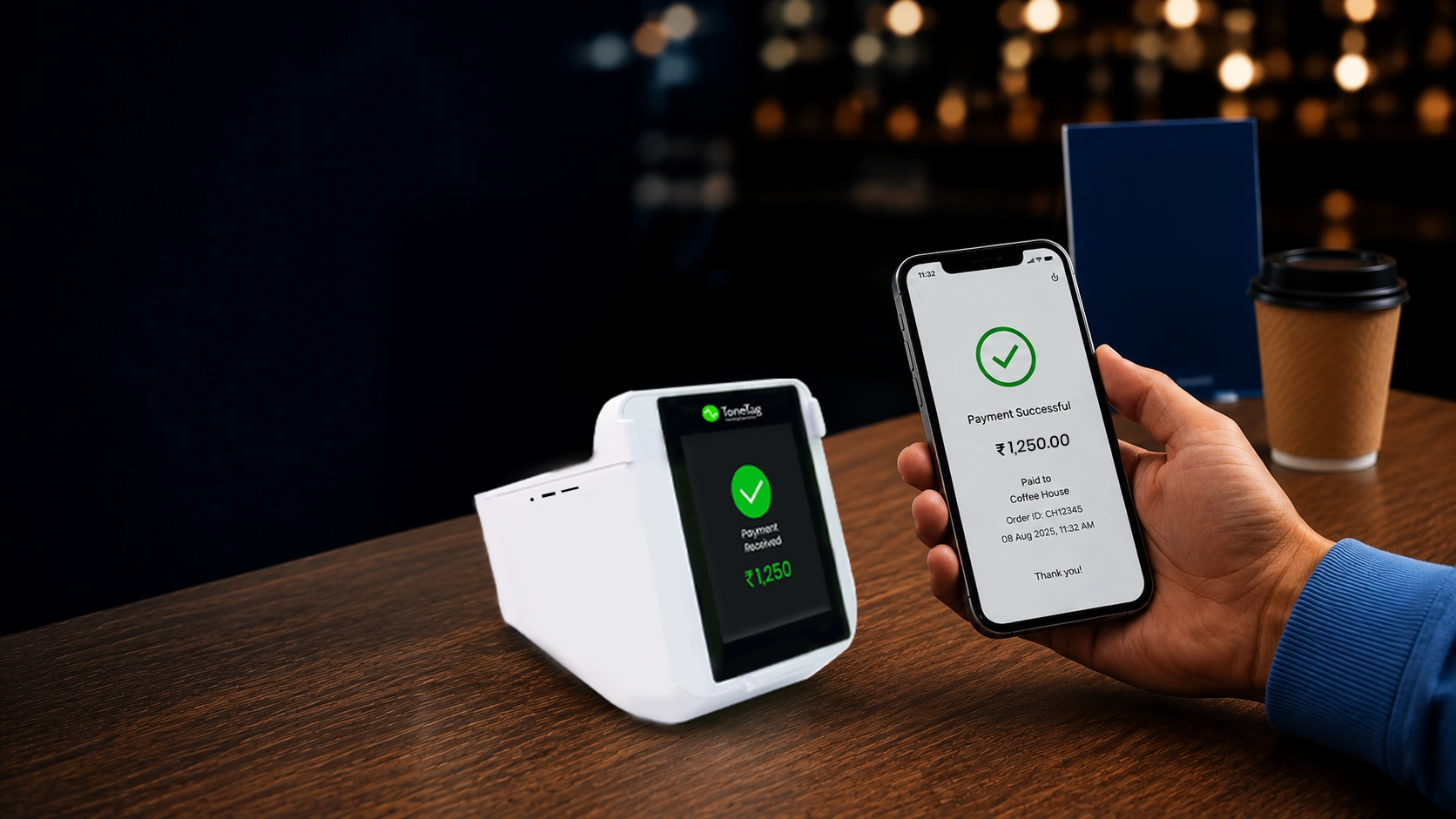
The mechanics of data over sound payments are closer to modulation than to magic. An encoder maps the transaction payload to a sequence of tones, the originating device emits it, the receiving device captures it through its microphone, and a decoder reconstructs the payload to trigger the flow. The signal can sit above the audible range, so the user experiences nothing but a confirmation prompt.
In a typical merchant flow:
- The terminal or merchant device encodes the bill into an audio sequence.
- The customer device captures and validates the sequence locally.
- Authentication is confirmed before anything settles.
- The transaction is queued for settlement and reconciliation.
What makes sound wave payment technology durable in production is signal discipline. Each sequence is distinct and built to survive ambient noise, and the same decoding logic runs on a terminal, a phone, or an embedded chip without new silicon. That portability is the reason sound behaves like infrastructure: write to the protocol once, and the medium travels wherever your devices do. ToneTag’s breakdown of data-over-sound as a transfer method is a useful reference for engineering teams scoping this.
Where sound fits against NFC, QR, and BLE
Sound is one option inside a wider family of proximity payment technology, and the experienced answer is rarely “sound instead of NFC.” It is “sound for the cases the others handle badly.”
- NFC is quick but assumes compatible secure hardware on both ends.
- QR is cheap but needs a screen, a camera, and a cooperative environment.
- BLE pairs cleanly but degrades in dense, noisy retail floors.
- Sound needs only components most devices already carry, and it holds up offline.
The architecturally sound move is to stop choosing. Support multiple proximity methods behind a single integration so the rail adapts to the context instead of the merchant adapting to the rail. ToneTag’s proximity payments protocol is structured for exactly this, spanning NFC, QR, and sound without a hardware rip-and-replace.
The number that justifies the work
Reach only matters if the addressable base is large. In India it is. The government’s Press Information Bureau reports that UPI processed more than 24,000 crore transactions in FY 2025-26, the bulk of it person-to-merchant. The instructive detail for an acceptance strategy is not the headline volume but its concentration in high-frequency, low-value retail, the exact segment where checkout friction and device limits bite hardest.
A meaningful share of that base still sits outside the smartphone economy. The Reserve Bank of India and NPCI built UPI123Pay because, as the Federal Reserve Bank of Kansas City documents, hundreds of millions of feature-phone users needed a route into digital payments. Sound-based acceptance speaks directly to that population, and to comparable connectivity and device gaps across GCC, SEA, and global enterprise deployments. The outcomes are measurable: more acceptance points per unit of hardware spend, fewer abandoned transactions, and payment-intent data you can actually act on.
Security and integration: how to scope it
Audio invites a fair objection about safety, and the credible framing is consistent with the transport-layer view. The sound itself carries the payload; the assurance comes from the encryption and authentication wrapped around it, and from keeping sensitive handling close to the device rather than exposed in transit. That is the posture to interrogate. Ask how the payload is protected, where authentication happens, and how much never leaves the device. Treat any specific certification as something to confirm in writing with the vendor before it enters a compliance review, not as a claim to inherit from a datasheet.
On integration, the practical appeal is a light lift. A protocol delivered through SDKs and APIs slots into existing terminals and apps without a stack overhaul, which compresses time to market. Engineering leads can evaluate the surface area directly through the ToneTag developer resources.
Misconceptions that slow good decisions
- It is not an offline-only trick. Offline resilience is a strength, but the same rail runs online and alongside UPI.
- It is not a single proprietary box. Sound is a method that spans devices, including conversational hardware such as ToneTag eKosha, which brings banking services to the countertop.
- It does not replace your stack. It extends it, sitting beside NFC, QR, and card rails rather than competing with them.
Where this is heading
Sound is becoming a quiet foundation for proximity and, increasingly, for voice-led and agentic commerce, where a transaction resolves through conversation rather than taps. Devices like eKosha show how one audio transport can carry both acceptance and richer merchant interaction on the same protocol. If you are mapping your next acceptance layer, the honest next step is to test it against your own constraints. See how agentic and voice-first payments build on this base, weigh the trade-offs in this look at voice-based versus traditional payments, or talk to the ToneTag team to scope an integration for your stack.
Frequently Asked Questions
What is sound based payment technology and how does it work?
Sound based payment technology completes transactions by encoding payment data into audio and transmitting it between two devices through their speakers and microphones. An encoder turns the payload into a sequence of tones, the receiving device captures and decodes it, and authentication confirms the payment before settlement. Because it depends on sound rather than a specific chip or screen, it runs on smartphones, feature phones, card machines, kiosks, and embedded devices. For infrastructure teams, this makes it less a single product and more a transport layer that extends acceptance across varied and low-connectivity environments.
Is sound-based payment secure enough for banks and merchants?
The sound carries the payload, while security comes from the encryption and authentication wrapped around it and from keeping sensitive handling close to the device rather than exposed in transit. Distinct, noise-resistant signal sequences add a further layer. The practical step for payment leaders is to interrogate the posture directly: how the payload is protected, where authentication occurs, and how much data leaves the device. Confirm any specific certification in writing with the vendor before it enters a compliance review, since these details vary by provider and should never be assumed from general descriptions.
How is sound-based payment different from NFC and QR proximity methods?
NFC, QR, and sound are all forms of proximity payment technology, but their requirements differ. NFC assumes compatible secure hardware on both devices. QR needs a screen, a camera, and manual scanning in a cooperative setting. Sound needs only a speaker and a microphone, which most devices already have, and it performs reliably offline. The stronger architectural approach is rarely to pick one rail. It is to support several behind a single integration so acceptance adapts to context and reaches users that any single method would otherwise exclude.
Does sound-based payment work offline and on feature phones?
Yes. Operating in low-connectivity and offline conditions is one of its defining strengths, because payment data moves through audio and can be validated on the device before syncing for settlement. This also makes it viable on feature phones, which matters in markets like India where a large population relies on basic handsets. For banks and acquirers, that extends digital acceptance into rural, semi-urban, transit, and unattended retail settings where app and card rails frequently struggle to reach reliably or cost-effectively.
Can sound-based payments integrate with UPI and existing acquiring stacks?
Yes. Sound-based methods are designed to sit alongside existing rails, including UPI, rather than replace them. Integration usually arrives through SDKs and APIs that slot into current terminals, kiosks, and apps with minimal change, which shortens time to market and avoids a hardware overhaul. A protocol approach also lets you extend the same foundation to conversational merchant devices such as eKosha, a merchant banking box. Engineering teams can review documentation and integration paths through the provider’s developer resources before committing budget to a rollout.