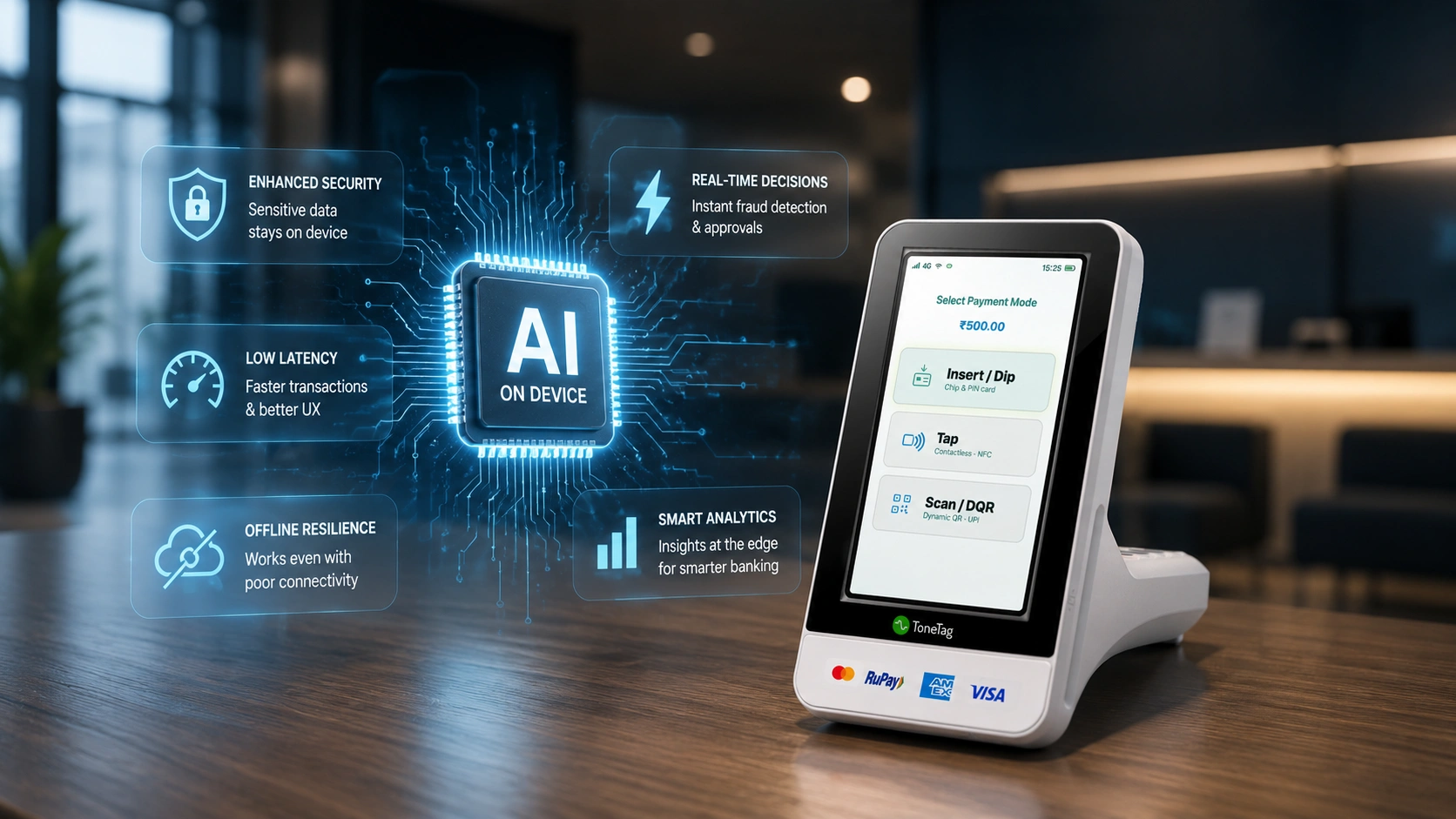
Banks have spent a decade pushing acceptance into smaller form factors. The soundbox on a kirana counter is now a frontline banking device. Yet most of that hardware still thinks in the cloud. Every confirmation, fraud check, and voice prompt makes a round trip to a server. That dependency is starting to cost banks money, reliability, and trust. On-device AI flips the arrangement. When intelligence lives on the hardware itself, payments get faster, cheaper to run, and resilient to weak networks. For banks scaling merchant acceptance across India, edge AI payments have moved well past the lab.
What edge processing actually means inside a payment device
Edge processing means the device does the thinking locally instead of shipping raw data to a distant server for every decision. An edge computing payment device runs authentication, transaction logic, and increasingly AI inference on a secure chip built into the hardware. The cloud still handles settlement, reconciliation, and reporting. But the payment moment itself, the confirmation, the fraud signal, the voice response, happens on the device.
A useful way to picture it: the decision moves from the data center to the countertop. The transaction completes even when the connection is patchy, then syncs once the network returns. The cloud becomes the system of record, not the bottleneck in every tap.
Why cloud-dependent devices are hitting a wall
India runs one of the largest real-time payment systems on the planet, and the acceptance footprint keeps widening. The government’s Payments Infrastructure Development Fund had deployed roughly 4.77 crore digital acceptance touch points by May 2025, much of it pushed into Tier-3 to Tier-6 markets. The RBI Digital Payments Index has climbed steadily, driven largely by expanded merchant acceptance.
Those are exactly the markets where connectivity is least reliable. A device that needs a live server call for every action fails precisely where banks most want to grow. Three problems compound. Reliability suffers in low-connectivity areas, where a missed server call turns into a dropped or delayed confirmation at the counter. Latency and recurring cloud cost climb as transaction volumes scale into the billions. And routing payment data to the cloud in real time widens the security surface a bank has to defend on every transaction.
How on-device AI rewrites the economics for banks
This is the part that reaches the balance sheet, not just the product roadmap.
Lower and more predictable cost. Fewer server calls mean less bandwidth and a smaller cloud bill per device across a fleet of millions. Industry analysis points the same way: edge deployments often deliver lower, more predictable total cost of ownership than cloud-only approaches, and the milliseconds lost round-tripping data to a distant server represent a structural vulnerability, not just lag.
Reliability where it matters. Local processing keeps the device working through outages, then batch-syncs queued transactions for settlement once connectivity is restored. For a bank, that is fewer support tickets and fewer merchants quietly falling back to cash.
A tighter security posture. On-device authentication, secure elements, and local data handling reduce real-time cloud exposure. Sensitive data does not need to travel for every transaction. (Any specific certification claim, for example PCI DSS or RBI and NPCI alignment, should be confirmed with ToneTag in writing before publishing.)
New data and new revenue. When a device captures SKU-level and behavioural signals locally, banks gain a richer view of the merchant. That feeds personalization, contextual cross-sell, and lending eligibility signals that turn a payment terminal into a customer-relationship asset.
This is where an edge AI soundbox earns its place in the stack rather than acting as a dumb confirmation speaker. ToneTag’s IoT and edge payment solutions are built so banks can roll this out without overhauling the existing acquiring stack. ToneTag eKosha, is a clear example: it processes locally and brings banking-grade capability to the device instead of tethering it to a server.
What this looks like on the ground
The shift is easiest to see in everyday merchant moments.
At a busy QSR during the lunch rush, an on device AI soundbox confirms each payment instantly without waiting on a server, so the queue keeps moving even when the in-store network is congested. At a kirana store with spotty mobile data, transactions still complete and settle later. And when a merchant simply asks the device, “What were my sales today?” or “Am I eligible for a working capital loan?”, eKosha can answer through conversational, voice-first interaction rather than a manual app lookup. That is banking services delivered to the countertop, powered by agentic and voice-first payment capability running close to the merchant rather than in a remote cloud.
What banks should weigh before rolling out
For a payments or product leader evaluating this, the question is rarely whether edge matters. It is how heavy the move is. A few practical checks help frame the decision. Look at how cleanly the edge solution sits alongside UPI, NFC, QR, and sound-based methods already in your stack, since minimal integration effort is the difference between a quarter and a year to market. Confirm the split between what runs on-device and what stays in the cloud, so settlement and reconciliation remain auditable. Review who owns the hardware and protocol IP, because that affects compliance control and release speed. Teams that want to scope integration can start with the developer documentation, SDKs, and APIs, and compare device options on the hardware product range.
Delaying the move is itself a decision. Competitors deploying edge-capable hardware will run cheaper, work in more places, and learn more about their merchants. That gap widens with every transaction.
Bringing It Together
Edge processing is not a feature upgrade for payment hardware. It is a change in where decisions happen, and that change lands directly on a bank’s cost base, reliability, security posture, and merchant relationships. The institutions that treat on-device AI as core acquiring infrastructure, rather than a soundbox accessory, will be the ones acquiring and retaining merchants at the lowest cost per point of acceptance. If you are mapping your next-generation acceptance strategy, explore ToneTag’s IoT and edge payment protocol or talk to the ToneTag team to scope what edge deployment looks like on your stack.
Frequently Asked Questions
What is an edge AI payment device and how is it different from a normal soundbox?
An edge AI payment device processes authentication, transaction logic, and AI inference on a secure chip inside the hardware, rather than sending every action to the cloud. A basic soundbox mainly plays an audio confirmation after a server confirms the payment. An edge device decides locally, so it works through poor connectivity and responds instantly. eKosha, a merchant banking box, is an example that brings banking-grade capability and conversational interaction to the device itself, turning the terminal into an active banking touchpoint instead of a simple alert speaker.
Why should banks invest in edge AI payments instead of cloud-only systems?
Cloud-only devices send data back and forth for every transaction, which adds latency, recurring infrastructure cost, and security exposure at scale. Edge AI payments keep the payment decision on the device, cutting server round trips and lowering the cloud bill across millions of terminals. They also stay reliable in low-connectivity markets, where banks are expanding fastest. For a bank, the result is lower cost per acceptance point, fewer failed transactions, and a stronger data relationship with each merchant, without ripping out the existing acquiring stack.
Are edge-based payment devices secure and compliant for banking use?
Edge devices can strengthen security because sensitive payment data does not travel to the cloud for every transaction. They typically rely on secure elements, on-device authentication, biometric checks, and local encryption, which reduces real-time exposure and the attack surface. This local handling also supports data residency expectations. Banks should still validate endpoint controls and confirm any specific compliance certification, such as PCI DSS or RBI and NPCI alignment, directly with the vendor in writing before deployment, since these vary by product and must be verified rather than assumed.
Can on-device AI soundboxes work offline in rural or low-connectivity areas?
Yes. That is one of the strongest reasons banks adopt them. An on-device AI soundbox processes and authenticates the transaction locally, stores it securely, and batch-syncs to central systems for settlement and reconciliation once connectivity returns. This keeps merchants accepting payments through network outages, which is critical in Tier-3 to Tier-6 markets and rural India where mobile data is inconsistent. For banks expanding acceptance into these regions, offline-capable edge hardware reduces dropped transactions and the quiet fallback to cash that erodes digital adoption.
How hard is it for a bank to integrate edge AI payment hardware into an existing stack?
It is lighter than a full overhaul when the solution is built as plug-and-play infrastructure. Protocol-based edge solutions are designed to sit alongside existing rails such as UPI, NFC, QR, and sound-based methods, integrating through SDKs and APIs rather than replacing core systems. Most of the work is connecting the device layer and defining what runs on-device versus in the cloud for settlement. This keeps time to market short. Banks can scope effort using developer documentation and start with a focused merchant segment before scaling the rollout fleet-wide.