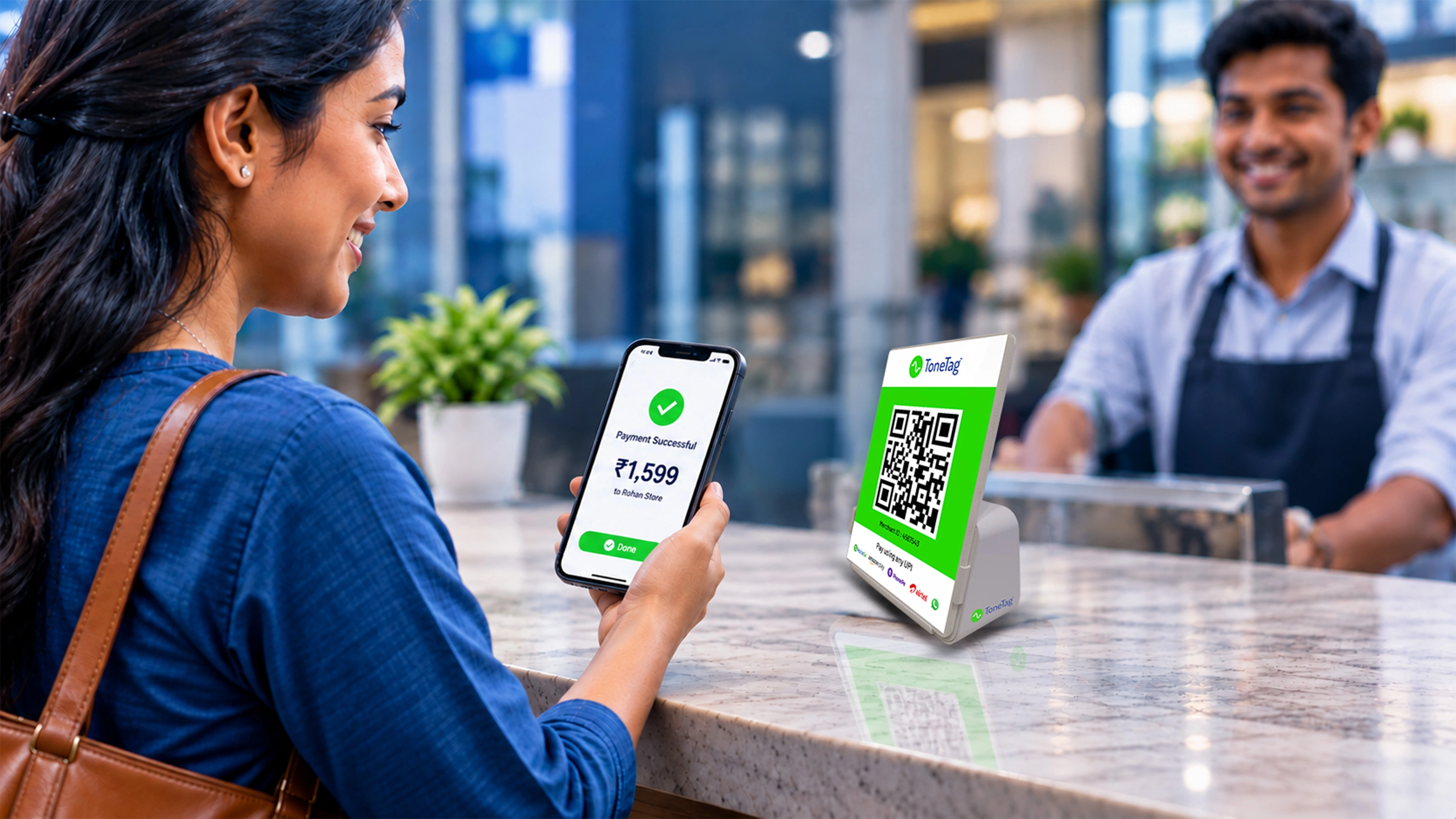
For years, the countertop device at an Indian merchant’s shop did one job: announce that a UPI payment had landed. Useful, but narrow. Today, the same footprint is being asked to carry credit decisions, working capital nudges, settlement views, and voice-led servicing in regional languages. For banks, PSPs, and acquirers building on ToneTag’s protocol, this shift is the opening to move from confirmation hardware to a live banking channel. ToneTag eKosha, sits at the centre of this evolution, turning the acceptance point into a two-way conversation between the bank and the small business owner.
Why Payment Alert Soundboxes Have Outgrown Their Original Job
The first generation of payment audio devices solved a trust problem. Merchants could keep serving customers without checking a phone screen. Volume, not depth, defined success. The next generation is different. It has to understand queries, resolve intent, and route the merchant into a banking workflow without a screen tap.
A voice AI banking device does three things the older category could not. It listens for natural language in Hindi, Kannada, Tamil, Bengali, and other Indian languages. It reasons on device using edge inference so latency stays low and recurring cloud cost stays controlled. And it responds with an outcome, not a menu.
That last point matters. When a kirana owner in Belagavi asks in Kannada how much settled to the account today, the device answers with a number and offers the next relevant action, such as a top up loan pre-approval. This is the difference between an IVR tree and a live agentic AI payments flow.
What a Modern Voice Banking Device Actually Does at the Counter
A soundbox with banking services is no longer a single-purpose speaker. It behaves closer to a compact branch, running audio-first workflows that used to require a mobile app or a relationship manager visit. Typical live capabilities include:- Payment confirmations across UPI, cards, and wallet inflows
- Daily and weekly settlement summaries on voice command>
- Balance and pending payout queries
- Onboarding into overdraft, savings, and insurance products
- Voice-led reconciliation for merchants who close books at night
How eKosha Turns Settlement Data Into Instant Merchant Credit
The category’s most interesting frontier is credit. India’s MSME sector has a persistent unmet credit demand running into trillions of rupees, a gap the International Finance Corporation has documented across successive studies. Traditional underwriting struggles because thin file merchants lack formal documentation. A voice-first acceptance device changes the input data.
Every settlement event, refund pattern, average ticket size, and payout gap becomes a signal. When those signals feed a lender’s decision engine, a merchant overdraft device can extend a pre-approved line right at the counter, disbursed to the linked account within minutes. The merchant hears the offer, accepts by voice, and completes consent on the same audio channel.
Soundbox loan and overdraft flows are already being piloted by banks that treat the acceptance layer as the cheapest customer acquisition channel they have. The unit economics are compelling. No branch visit, no field agent cost, and the collateral is behavioural cashflow. For lenders building on ToneTag’s hardware product and protocol, this is the shortest path from acceptance data to earning asset.
Why Voice-First Banking Hardware Improves Unit Economics for Banks and PSPs
Three shifts are compressing the cost of servicing small merchants. First, voice-first interfaces remove the smartphone dependency that stalled digital banking penetration in tier three and four markets. Second, edge inference on the device reduces recurring cloud spend per interaction. Third, the same hardware footprint now carries multiple revenue lines: interchange, subscription, credit origination fees, and cross sell.
The RBI’s Financial Inclusion Index has expanded meaningfully year on year, but usage depth remains uneven. Devices that speak the merchant’s language close that depth gap faster than any app update. For a PSP under margin pressure, that is a real answer to the acquisition cost problem, and it is a large part of why voice-based payments are being taken seriously in bank product roadmaps this cycle.
What Banks and PSPs Should Scope Before Rolling Out a Voice Banking Device
The build decision is rarely about the microphone. It is about how the device sits inside an existing acquiring stack. ToneTag’s protocol is designed to integrate through SDKs and APIs without forcing a stack overhaul, and it works alongside UPI, NFC, QR, and data over sound rails. That matters when a bank wants to pilot with fifty merchants before scaling to fifty thousand.
Common considerations engineering and product leads should scope early include language coverage priorities, the offline fallback path when connectivity drops, the split between on device and server side inference, and how the device authenticates the merchant for higher trust actions such as loan acceptance. Teams evaluating proximity payments or extending into IoT payments can reuse most of the same integration primitives, which shortens time to market.
Turning the Merchant Counter Into a Full Service Banking Channel
The countertop is becoming the branch. For banks, fintechs, and acquirers, the strategic question is no longer whether to deploy audio devices, but how quickly to move from alerts to a full banking channel that underwrites, services, and cross sells in the merchant’s own language. Teams ready to explore the protocol can talk to the ToneTag team or begin scoping integration through the developer resources to see how eKosha and the underlying rails fit their acquiring roadmap.
Frequently Asked Questions
What makes a modern audio-first banking device different from an alert only device?
The older category was built to confirm one thing: money in. The newer category is built to hold a conversation. It captures natural language in Indian languages, understands intent, and executes banking workflows on the same channel. Merchants can check settlements, accept credit offers, and complete servicing without opening an app. For banks and PSPs, this turns the acceptance point into a distribution channel for savings, insurance, and working capital, not just a payment receipt speaker. eKosha is built for exactly this shift.
How does eKosha extend a pre-approved credit line to a small merchant?
eKosha reads settlement patterns, ticket size trends, and payout consistency as live signals. Partner lenders feed those signals into an underwriting model that pre-approves a working capital line for eligible merchants. The device announces the offer in the merchant’s language, captures voice consent, and triggers disbursal to the linked account. No branch visit is required. This turns thin file merchants into serviceable borrowers using their own cashflow behaviour as collateral, which is often more predictive than paper based documentation for this segment.
Do voice-led banking devices work in low connectivity or offline environments?
Yes, within limits. Well designed audio banking hardware runs core inference on device, so payment confirmations, balance checks, and voice prompts continue during intermittent connectivity. Actions requiring bank rails, such as loan acceptance or fund transfers, queue locally and complete when the network returns. The design principle is graceful degradation, not full offline banking. This matters for tier three and four deployments where connectivity is uneven. Product teams should scope the offline fallback path early in the pilot to match on ground merchant expectations.
What integration effort does a bank need to launch a voice banking device pilot?
Most launches move faster than teams expect because ToneTag’s protocol integrates through SDKs and APIs without a full stack rebuild. A typical pilot covers language coverage, edge versus server inference split, merchant authentication for higher trust actions, and reconciliation flows. Banks with existing UPI, QR, and NFC acquiring can reuse most rails. A fifty merchant pilot commonly runs in weeks, not quarters. Certification timelines and internal risk reviews are usually the longer path items, not the technical integration itself.
Is voice authentication secure enough for banking transactions on a shared counter?
Voice is one factor, not the only one. Production deployments layer voice with device binding, tokenised session identifiers, and step up confirmations for higher value actions such as credit acceptance or fund movement. Sensitive data is processed on devices where possible, which reduces real time cloud exposure. The specific security stack, encryption model, and any compliance certifications should be verified directly with the bank or protocol partner before public claims are made. Safety comes from layered controls, not a single voice match.