
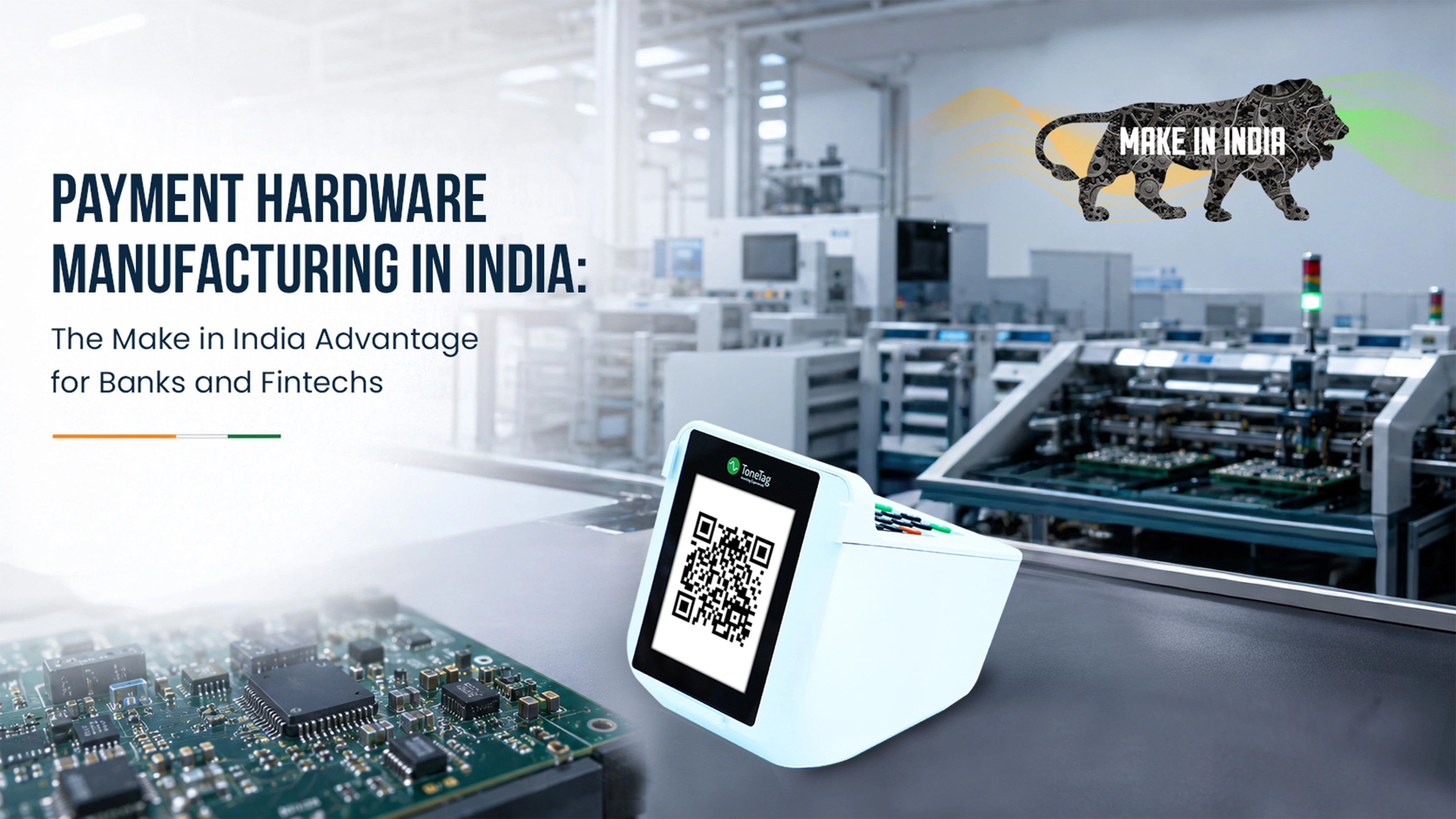
Behind every digital payment sits a piece of hardware. A soundbox confirming the amount, a terminal reading a card, a QR speaker on a counter, a reader on a transit gate. For years, much of that hardware was designed and assembled outside India. That gap has quietly become a strategic question for any bank or fintech scaling acceptance. Choosing a made in India payment device is no longer a simple procurement preference. It shapes data control, supply chain stability, unit economics, and how quickly you reach merchants across Bharat. This guide breaks down where the Make in India advantage is real, and what payments and product leaders should weigh before they commit.
Why Payment Hardware Is Becoming a Strategic Asset
Soundboxes, POS terminals, and QR speakers were long treated as commodity tin. The logic was simple: source the cheapest reliable unit and ship it. That logic is breaking down.
India deploys payment acceptance hardware at a scale few markets match. Through the Payments Infrastructure Development Fund, around 4.77 crore digital touch points had been deployed across the country as of May 2025, with deep penetration into tier 3 to tier 6 towns. Acceptance volume is no longer the constraint. The supply chain behind the devices is.
Much of that supply chain still sits offshore. When Paytm pushed for a production-linked incentive on payment devices, it noted that most devices deployed in India were still made in the US or China. For a bank or PSP placing millions of units, that dependence carries real cost, lead-time, and control risk.
The compliance and data angle
There is a regulatory reason to care about where a device and its data pipeline originate. The RBI’s data localisation directive requires that payment system data be stored only in systems located in India. Hardware designed locally, with edge processing and on-device authentication, makes that easier to honour, because sensitive data can be handled close to the point of capture rather than routed through distant cloud regions. Any specific certification posture, such as PCI DSS or RBI and NPCI approvals, should be confirmed directly with the manufacturer before you rely on it in a procurement decision.
Where the Make in India advantage shows up
The benefits cluster into a few areas that matter to decision-makers.
The first is supply chain resilience. A domestic line shortens lead times, reduces exposure to currency swings and shipping shocks, and lets you scale device orders in step with merchant onboarding rather than ordering quarters ahead. The second is cost over time. Manufacturing under Make in India can tap incentive structures such as the electronics PLI scheme, while higher local volumes justify investment in tooling and quality control, which compounds into a lower per-unit cost as you scale.
The third is speed of rollout and service. A working relationship with a payment hardware manufacturer India based close to your merchant base means faster repairs, firmware updates, and replacement cycles, which protects merchant uptime in remote locations. The fourth, and most underrated, is fit. Devices built in-market are designed around how Indian merchants actually transact.
Built for India, not adapted to it
A device made for a Mumbai dairy stall or a Coimbatore textile shop has different demands than one designed for a Western retailer. It needs to confirm payments aloud in regional languages, survive dust and power fluctuation, work in patchy connectivity, and stay cheap enough for a one-rupee daily rental. Paytm made a similar point, arguing it builds in India to better understand the nuances of local merchant use cases. A soundbox manufacturer in India that designs for these constraints from the start produces hardware that simply performs better in the field than a re-badged import.
What to evaluate in a hardware partner
If you are a bank, acquirer, or fintech assessing a payment soundbox manufacturer india side, weigh more than the spec sheet. Look at whether the protocol is open to your stack through SDKs and APIs, whether the device supports multiple acceptance methods such as NFC, QR, and sound, and whether processing can run at the edge to cut cloud load and latency. India’s merchant acquiring market reached about 611 million dollars in 2024 and is projected to grow at roughly 12 percent a year, so the partner you choose now should scale across that curve without a stack rebuild.
ToneTag approaches this as a protocol and infrastructure layer rather than a finished service. Its hardware product range and edge and IoT payments stack are built to plug into existing payment systems with minimal change, keeping data local through on-device authentication. For practical context on how these deployments behave with real merchants, the ToneTag merchant deployment stories are a useful read.
Beyond the soundbox: edge and conversational layers
The frontier is not just where a device is built, but what it can do. The next generation of merchant hardware moves past payment confirmation into banking infrastructure. Tonetag’s eKosha, shows the direction. It brings banking-grade interaction to the countertop, letting a merchant ask questions and act on them in their preferred language rather than tapping through an app.
This is where domestic design and agentic, voice-first payments intersect. A device that processes intent at the edge, responds in regional languages, and is built for Indian power and network conditions is hard to replicate from offshore. eKosha is positioned exactly here, as a locally built device that treats the merchant counter as a banking surface, not just a payment endpoint.
The decision in front of banks and fintechs
The question is no longer whether digital acceptance will keep growing. It is who controls the hardware, the data, and the merchant relationship beneath it. Building on locally manufactured, edge-capable, protocol-driven hardware gives banks and fintechs control on all three. Delaying that choice means inheriting someone else’s supply chain and someone else’s roadmap.
Ready to evaluate locally built payment hardware for your network? Explore how the ToneTag protocol fits across acceptance methods, or talk to the ToneTag team to map a rollout for your merchant base.
Frequently Asked Questions
Which payment device makers in India are best suited for banks and fintechs?
The right fit depends on control, not just price. Look for a partner whose hardware is locally manufactured, supports multiple acceptance methods like NFC, QR, and sound, and processes payments at the edge to keep data within India. Banks and fintechs also benefit from an open protocol exposed through SDKs and APIs, so devices integrate without a stack rebuild. ToneTag fits this profile as an infrastructure layer rather than a finished service, with locally built devices such as eKosha designed for Indian merchant conditions and regulatory expectations.
Do locally built payment devices help with RBI data localisation?
They make compliance easier, though they do not replace it. The RBI requires that payment system data be stored only in systems located in India. A device designed with edge processing and on-device authentication can handle sensitive transaction data close to the point of capture, reducing how much travels to distant cloud regions. That local-first architecture aligns naturally with localisation rules. Banks should still confirm a manufacturer’s specific certifications and audit posture in writing, since hardware origin supports compliance but does not by itself prove it.
How does domestic soundbox production lower costs for acquirers?
Local production shortens supply chains, which cuts lead times, shipping costs, and currency exposure. It lets acquirers order devices in step with merchant onboarding instead of committing capital quarters ahead. Manufacturing under Make in India can also access incentive structures like the electronics PLI scheme, while higher local volumes justify better tooling and quality control. Faster in-country repair and replacement cycles reduce downtime in remote merchant locations too. Together these factors lower the total cost of running a large device fleet, not just the sticker price per unit.
What should a bank look for when choosing a local device partner?
Start with integration. The protocol should be open through SDKs and APIs so devices slot into your existing payment stack with minimal change. Check for multi-method acceptance across NFC, QR, and sound, and edge processing that keeps data local and reduces latency. Assess supply chain reliability, in-country service coverage, and the ability to scale with merchant growth. Finally, confirm security and certification claims in writing. A partner like ToneTag, offering protocol, hardware, and conversational layers such as eKosha together, reduces the number of vendors you have to coordinate.
What is eKosha and how does it differ from a standard soundbox?
eKosha, is a merchant banking box built on the vision of “Banking Beyond Branches. Voice-First for Every MSME”. It brings banking-grade, conversational interaction to the merchant counter, letting a shopkeeper ask questions and act on them in their preferred language rather than navigating an app. Where a standard device announces a transaction, eKosha is designed to process intent at the edge and turn the counter into a banking surface. Built for Indian power, connectivity, and language conditions, it represents the shift from simple payment hardware toward agentic, voice-first commerce that is difficult to replicate from offshore production lines.