Every merchant banking dashboard tells the same story. Download numbers look healthy. Weekly active use drops off a cliff by month two. Support tickets skew heavily toward “how do I check my balance” from merchants who installed the app months ago and never came back. The pattern is not adoption failure. It is an interface failure. A shopkeeper running a counter cannot stop mid-transaction to unlock a phone, wait for a screen to load, and thumb through menus in a language they did not choose.
Voice-first banking answers with a different design. The merchant speaks in their preferred language, a device at the counter listens, and the banking service responds. No app. No typing. No screen.
The Real Cost of App-Only Merchant Banking
Most merchant banking apps were designed for consumers who happen to run a shop, not for operators running a counter. That mismatch shows up in adoption data. A PayNearby MSME Digital Index survey found that resistance to new technology and implementation costs remain top blockers for small businesses, with clear language preferences shaping how technology gets used at the shop level.
The friction stacks up quickly. A shop assistant handling twenty walk-ins an hour cannot pause to unlock a phone, wait for an app to load, and navigate deep menu trees. Owners in Tier 2 and Tier 3 markets often share devices between family and staff, which makes login-heavy flows a security risk as much as a usability one. The scale of merchants left behind by app-only design is significant enough that the RBI and NPCI launched UPI 123Pay specifically to reach roughly 400 million feature-phone users through IVR, missed calls, and sound-based rails.
The result is familiar to any product team: high app downloads, low daily active use, and banking services that never quite reach the counter.
What Voice-First Banking Actually Does at the Counter
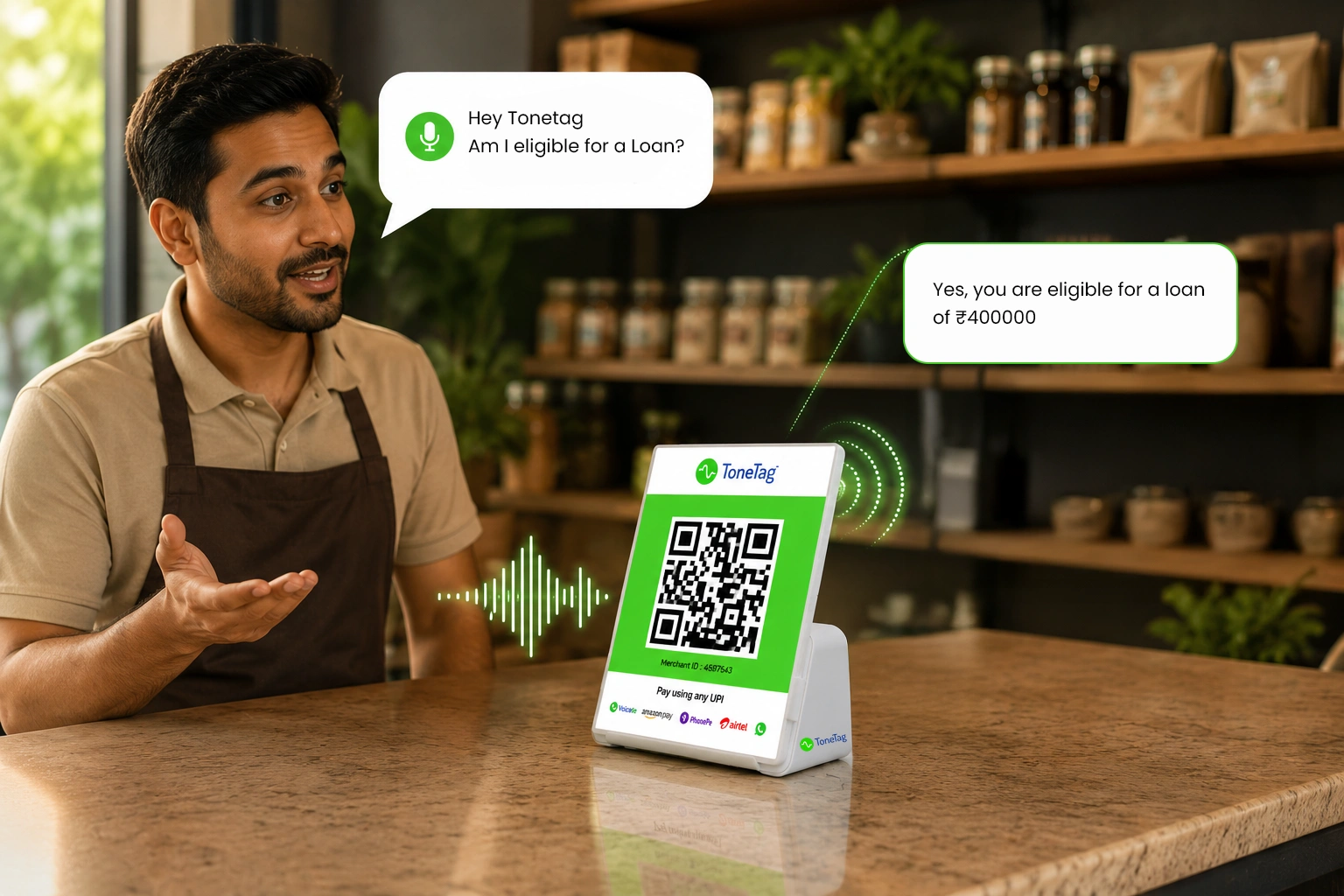
Voice-first banking replaces the app entirely as the interaction layer. Instead of tapping through menus, the merchant speaks a request in their preferred language and hears the answer back through a dedicated device at the counter. “What is my balance?” “Did the last UPI payment come in?” “How much did I collect today?” “Can I get a working capital top-up?” All of it moves through natural conversation, with no smartphone in the loop.
ToneTag’s edge AI merchant device, eKosha, is built around exactly this idea. Its positioning is direct: Banking Beyond Branches. Voice-First for Every MSME. The device sits on the counter, listens for wake words in local languages, and responds with account information, transaction confirmations, and service prompts in the same voice the merchant used to ask.
Because the interaction happens on the device itself, there is no dependency on a shared phone, no login-out cycle between staff, and no reliance on stable data connectivity for basic queries. For a bank or fintech, this converts a low-touch mobile app into a high-frequency counter service that runs through every shift, every day.
How the Voice Layer Works Without Screens or Typing
Three layers make app-less banking usable in a merchant environment. The first is on-device conversational AI, which processes speech locally so common queries do not travel to the cloud on every request. That keeps latency low, protects sensitive account context, and holds up in low-bandwidth zones.
The second is a proximity and sound-based payments layer that lets the device confirm transactions, exchange tokens with nearby phones, and verify collections without a QR scan or an app-to-app handoff. Banks and fintechs plug into this through ToneTag’s proximity payments infrastructure, which supports NFC, QR, and data-over-sound in a single stack.
The third is an agentic layer that turns spoken intent into completed actions. When a merchant asks for a settlement summary or a loan top-up, an underlying agent authenticates the request, calls the right bank API, and returns a spoken confirmation. This is the same design pattern documented on ToneTag’s agentic AI payments page, adapted for the counter rather than the consumer app. Integration teams evaluating the SDK and API surface can start with the ToneTag developer resources.
Where Voice-First Banking Fits Naturally
The counter is only the starting point. Voice-first banking removes screens and typing from any high-throughput environment where a phone is either impractical or unsafe to hold. At a QSR counter, staff can confirm bulk order collections between rushes without pausing to check an app. At a fuel forecourt, attendants can verify payments and log shift totals hands-free while managing dispensers. At transit gates and parking kiosks, operators reconcile daily takings by asking a spoken question rather than tapping through a dashboard. Delivery hubs and warehouse counters gain the same benefit for cash-on-delivery reconciliation. A PwC India analysis of MSME technology adoption notes that lack of technical expertise and financial resources continue to constrain digital transformation for small operators, which makes low-friction interfaces a practical necessity, not a design preference. Voice removes the interface question entirely. Adjacent scenarios covered in ToneTag’s writing on voice-based payments and connected commerce show how the same rail extends into connected cars, kiosks, and other unattended environments.What Banks and Fintechs Gain by Building on a Voice Layer
For the integrating institution, a voice-first layer changes the unit economics of merchant banking. Distribution is no longer bounded by app downloads or smartphone penetration. A bank can reach a fuel-station operator, a QSR franchisee, and a transit-gate contractor through the same device stack, using the same SDKs and settlement APIs.
Data quality improves because interactions happen through named, authenticated sessions on a dedicated device rather than shared phones. Engagement rises because the merchant does not have to switch context to check balances, request credit, or confirm collections. Cross-sell for working capital, insurance, and merchant credit becomes a spoken prompt at the moment of a completed transaction, not a push notification that gets swiped away.
Products like eKosha, deployed alongside ToneTag’s hardware product portfolio, give banks a ready path to move from app-only outreach into a persistent, voice-first channel at the counter. Integration effort stays low because the protocol sits on top of existing acquiring, UPI, and card rails instead of replacing them.
Building the Next Layer of Merchant Banking
App-only banking will keep serving digital-native merchants well. It will keep leaving out the operators who make up most of India’s counter economy. Voice-first banking closes that gap without asking merchants to change their behaviour or their language. For banks, fintechs, and PSPs planning the next phase of merchant engagement, the practical step is to see the protocol in operation and map it to your stack. Teams evaluating deployment can talk to ToneTag about pilot options and integration timelines.
Frequently Asked Questions
What Is Voice-First Banking for Merchants?
Voice-first banking lets a merchant complete banking tasks by speaking, without opening an app or typing on a screen. The merchant asks questions like “what is my balance today” or “did the last payment arrive,” in their preferred language and a dedicated counter device responds in the same language. It covers balance checks, settlement confirmations, working capital requests, and daily collection summaries. For banks and fintechs, it turns a low-engagement mobile channel into a persistent counter service, reaching merchants who share phones, prefer regional languages, or cannot pause work to tap through menus during a busy shift.
How Is Voice-First Merchant Banking Different from a Standard Payment Acceptance Device?
A standard payment acceptance device confirms that a transaction has succeeded and plays an audio confirmation. That interaction is one-way and payment-only. Voice-first merchant banking is a two-way conversational layer that handles balance checks, settlement queries, credit requests, and service prompts alongside payment confirmations. The device listens, understands the merchant’s language of choice, authenticates the merchant, and completes the requested action through bank APIs. eKosha is an example of this design applied to Indian counters, running as a dedicated banking interface at the point of sale rather than a payment-only endpoint or a mobile app.
Does Voice-First Banking Work Without Internet or Smartphones?
Voice-first banking is designed to reduce dependence on data connectivity and personal smartphones. Common queries are processed on the device through on-device conversational AI, so latency stays low and basic functions remain available in low-network zones. Payment confirmations can also travel over sound-based and proximity rails that do not require an active data session at the moment of transaction. For merchants and staff who use feature phones or share a device, this makes counter banking usable through every shift without asking anyone to install, unlock, or log into a mobile app.
Which Merchant Businesses Benefit Most from Voice-First Banking?
Any counter or gate that runs high transaction volumes with limited staff attention benefits most. QSR counters, fuel forecourts, transit gates, parking kiosks, warehouse delivery hubs, and multi-outlet retail chains see the clearest impact because staff cannot pause to open an app during a rush. Voice-first banking is also useful for owner-operated MSMEs where language and literacy make screen-based apps a barrier. For banks, this segment is often high-value but under-served because app-based distribution never converted into daily active use at the shop floor across Tier 2 and Tier 3 markets.
How Can a Bank or Fintech Integrate Voice-First Banking?
Integration typically layers on top of existing acquiring, UPI, and core banking rails rather than replacing them. Banks and fintechs connect through SDKs and APIs to a protocol partner like ToneTag, which handles the on-device conversational AI, multi-language coverage, and proximity payments layer. Merchant-side hardware such as eKosha is then deployed at counters. Rollouts usually start with a limited merchant cohort to validate voice flows, service coverage, and settlement, then scale across geographies. Overall timelines depend more on internal review cycles than on the protocol, which is engineered for minimal stack change.