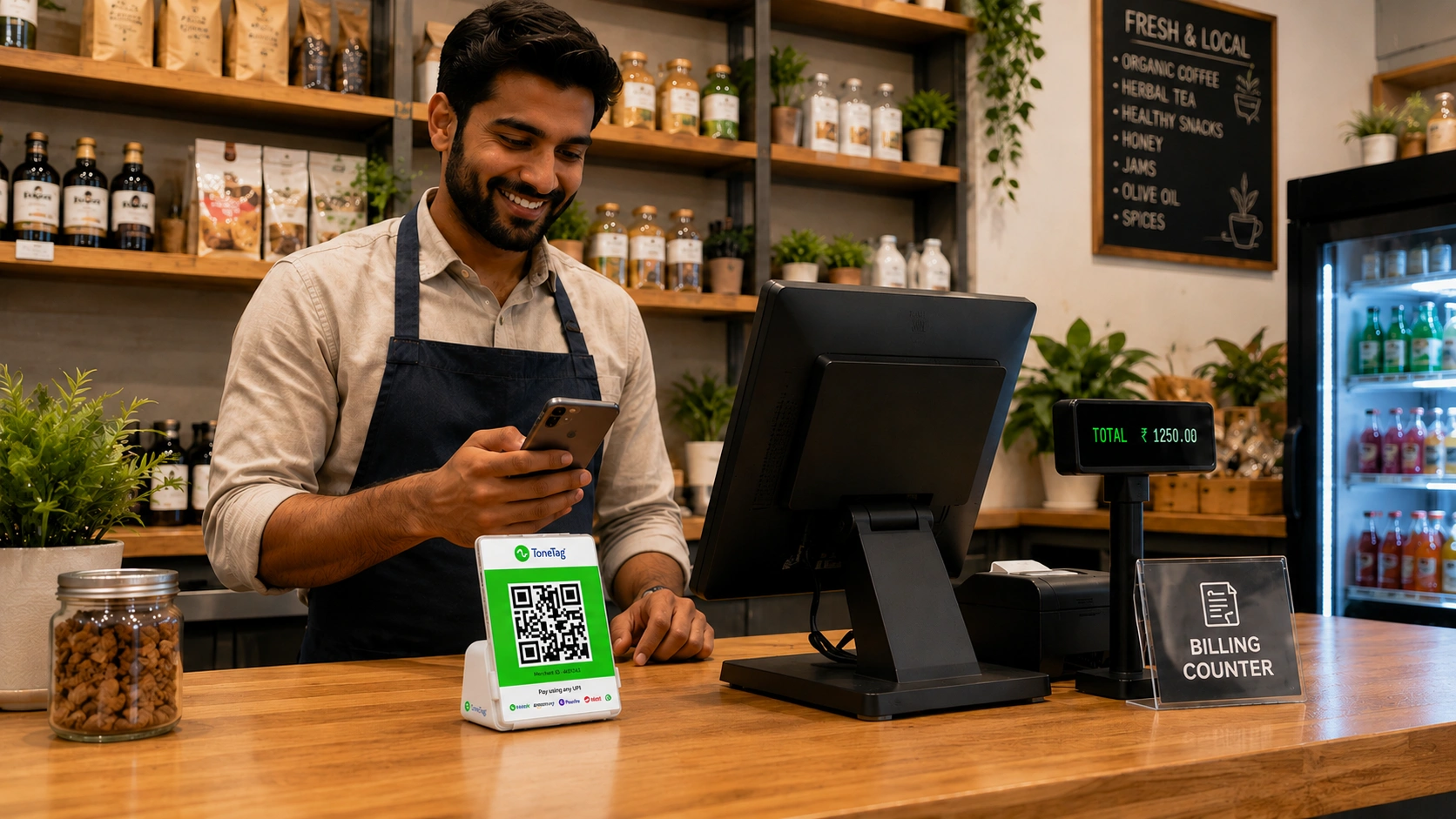
The merchant counter has become an increasingly important touchpoint for banks and acquirers. While soundboxes were initially designed to confirm payments, their role can now expand to address broader merchant needs. Many small businesses still face challenges accessing timely banking support while managing their daily operations, creating an opportunity for intelligent devices that bring relevant banking services closer to the point of business.
For banks and acquirers, this opens a new channel to deepen merchant engagement, deliver value-added services, and create stronger relationships beyond payment acceptance. This shift in requirement is what eKosha is built for.
This guide explains how the merchant banking device category has changed, how eKosha uses on-device AI to redefine the counter, and what to weigh before you deploy.
Why the Old Payment Confirmation Speaker Stopped Being Enough
The first generation of merchant audio devices solved a narrow problem. They announced incoming payments so a shopkeeper did not need to check their phone. Useful, but limited. A QSR operator could not ask the device how the day’s sales went compared to last week. A fuel forecourt manager could not check whether the outlet qualified for working capital. The gap between voice-based and traditional payment experiences became hard to ignore. The opportunity is large. India’s merchant acquiring market reached about $611.21 million in 2024 and is projected to grow at double digits through 2031, while retail digital payments are expected to roughly double to $7 trillion by FY30 on Kearney estimates cited in the same analysis. Volume alone no longer differentiates one device from the next. Merchants now expect their counter device to do more than beep, and that expectation is what pushed the category toward intelligence.What Modern Voice-First Banking Devices Look Like
The shift that matters is where computation happens. A traditional device sends almost every request to a central server, waits, and returns a result. An edge computing payment device flips that model. It authenticates, processes, and responds on the device itself, syncing with central systems only when needed. Globally, the edge AI market is projected to grow from roughly $24.91 billion in 2025 to $118.69 billion by 2033, and merchant payment devices are riding that curve. This is the foundation of edge AI payments: low-latency responses, offline resilience, and reduced cloud exposure. On-device authentication handles identity through secure elements and biometrics, so sensitive data does not travel to the cloud for every action. Local processing lets the device complete transactions even when connectivity drops, queuing them for batch settlement and reconciliation once the network returns. An edge AI soundbox category has emerged around this architecture, and the newer generation of merchant banking devices is built on it.eKosha Reframes the Counter as a Banking Touchpoint
This is where eKosha changes the category. Rather than acting as a payment confirmation speaker, eKosha brings genuine banking services to the point of sale, powered by conversational, agentic AI running on the device.
A merchant can speak naturally to eKosha in their preferred language and get an answer. A shopkeeper can ask “What were my sales today?” and hear an instant summary. They can ask “Am I eligible for a business loan?” and receive a contextual response built on their own transaction history. They can check settlements, track dues, or trigger a payout through conversation rather than a separate smartphone app. Because the intelligence sits on the device, these interactions stay fast and work in the low-connectivity environments common across Bharat. eKosha treats the counter as a banking touchpoint, not just a payment endpoint. For banks and acquirers, that turns one device into a channel for deposits, credit, and merchant engagement.
How On-Device Intelligence Changes What Happens at the Counter
The practical difference is what the device can do without a round trip. An on-device AI soundbox layer interprets voice and intent at the edge, so a merchant or MSME’s question does not have to wait for a cloud response before it becomes a useful answer. That matters for two reasons.
- First, speed. A voice-first device that stalls on a network call breaks the counter workflow. Local inference keeps replies within the rhythm of a live transaction.
- Second, privacy. Less data in transit means fewer opportunities for data exposure, and sensitive transaction and identity signals stay local unless they need to sync.
The same design unlocks new merchant workflows. Personalised offers based on repeat customer patterns. Credit prompts triggered by cash-flow signals. Multilingual voice interactions that respect regional preferences. All of it happens on the same device that took the payment, drawing on the same data-over-sound and edge architecture that powers ToneTag’s wider stack.
What Banks, Acquirers, and MSMEs Gain
The value is measurable. Faster checkouts and fewer abandoned transactions improve throughput at busy counters. Expanded acceptance across UPI, NFC, QR, and sound-based rails widens the addressable customer base without new infrastructure. Lower cloud dependency cuts running costs and compliance overhead. Conversational banking features open new revenue streams, from lending to value-added services, while deepening the data relationship with each merchant.
For an acquirer, this reframes the economics. A device that only confirms payments is a cost center. A device like eKosha that surfaces credit eligibility and sells services becomes a revenue channel with longer customer lifetime value. That is why banks looking at IoT and edge payments are shifting device strategy toward conversational, edge-ready endpoints rather than incremental upgrades to the old payment acknowledging soundboxes.
What to Check Before You Deploy
A few questions separate a smooth rollout from a stalled one. Ask how the device integrates with your existing stack, since SDK and API driven deployment should avoid a full overhaul. Confirm how it behaves offline and how queued transactions reconcile. Review the security model, including encryption, secure elements, and where authentication happens. Any compliance or certification claim should be verified in writing before you commit. Weigh time to market, since edge-ready devices with plug-and-play integration ship faster than custom builds. ToneTag’s protocol is designed to sit alongside rails like UPI with minimal stack change, which is what makes the model practical at Bharat scale.Bringing Banking Intelligence to Every Counter
Merchant banking devices are no longer defined by a beep. At the counter, the category now describes intelligent endpoints that process payments, authenticate locally, and hold a conversation about a merchant’s money. eKosha shows what that future looks like in practice. Ready to bring banking to the countertop? Explore the ToneTag device range or talk to our team to map it to your stack.Frequently Asked Questions
How does eKosha compare to a standard white-label soundbox for banks and acquirers?
A standard white-label soundbox usually announces incoming payments and little more. eKosha is built on a different architecture. It runs conversational, agentic AI on the device itself, letting merchants query sales, settlements, and credit eligibility in their preferred language. For banks and acquirers, that means the same device doubles as a channel for lending and value-added services rather than a single-purpose confirmation tool. eKosha can also be deployed under a partner brand, so it delivers white-label economics with the depth of a genuine banking touchpoint at the counter.
Can eKosha be deployed as a white-label solution for banks and fintechs?
Yes. eKosha is designed to be integrated into a bank, fintech, or acquirer’s existing stack and taken to market under their own brand. The ToneTag protocol sits alongside rails like UPI and supports plug-and-play deployment through SDKs and APIs, so partners avoid a full stack overhaul. That lets a bank offer an edge AI merchant device that carries its identity, its onboarding flows, and its credit and deposit products, while the underlying conversational intelligence is powered by eKosha. Specific commercial terms and configurations are worked out directly with the ToneTag team.
What does it cost to deploy eKosha at scale?
Pricing depends on deployment size, feature scope, integration model, and support requirements, so a single list price is not meaningful for enterprise buyers. Costs are typically shaped by device volume, the depth of conversational and banking features enabled, integration effort across your existing acquiring and core banking stack, and rollout support. Because eKosha runs intelligence on the device, running costs tend to be lower than cloud-heavy alternatives over time. For a scoped quote and total cost of ownership view, the ToneTag team works through your requirements directly.
How do banks and acquirers earn revenue from deploying eKosha?
Revenue comes from turning the device into a distribution channel. A device that only confirms payments is a cost center. eKosha surfaces credit eligibility, drives deposit growth, and enables value-added services through natural voice, giving banks and acquirers new fee and interest income per merchant. It also expands acceptance across UPI, NFC, QR, and sound-based rails, which increases transaction volume. Lower cloud dependency reduces running costs, and richer merchant data improves credit decisioning. Together, these shift the economics from a subsidised device to a channel with measurable customer lifetime value.
How can a bank, acquirer, or fintech get started with eKosha?
Getting started begins with a scoping conversation. The ToneTag team maps your existing acquiring, core banking, and merchant onboarding stack, identifies where eKosha fits, and outlines the integration path through SDKs and APIs. From there, a focused pilot is usually the next step, with a defined merchant segment and success metrics, before rolling into scaled deployment under your brand. Compliance and security requirements are reviewed and verified in writing at this stage. To begin, reach out through the ToneTag contact page or ask your partnerships lead to set up a briefing.